Pages

Showing posts with label books. Show all posts

Tuesday, September 7, 2021

Overcoming Dyslexia: Second Edition (Shaywitz & Shaywitz, 2020)

Image source: Amazon.com (2021.09.07 [highlighted, PB])             

For adult learners, parents, and teachers keen on learning about reading disorders, dyslexia in particular, an updated book appears to be an important addition to the field.

According to the Amazon book blurb, this edition of Overcoming Dyslexia by Shaywitz and Shaywitz (2020) offers "new information on all aspects of dyslexia and reading problems, and ... the tools that parents, teachers, and all dyslexic individuals need" (Read more, para. 1). The audible sample (Listen [1st author reading aloud?]) starts in Part I, Chapter 1, The Power of Knowing (Look inside, pp. 3-5) at Amazon.com

An Online Tutor Business Coach, Joanne Kaminski, who recently streamed a video review, argued that a crucial take-away from this book about dyslexia is the importance of early diagnoses (2021.08.30).

References

Kaminski, J. (2021.08.30). Overcoming Dyslexia Review [online video recording]. https://youtu.be/hscEptUgg_A

Shaywitz, S. E., & Shaywitz, J. (2020). Overcoming dyslexia: A major update and revision of the essential program for reading problems at any level, incorporating the latest breakthroughs in science, educational methods, technology, and legal accommodations. Alfred A. Knopf.


Wednesday, November 1, 2017

Teachers' resource book in the KGU library

One of the last times we met in the KGU library, the title on the spine of a book (Shin & Crandall, 2014) caught my eye. So I pulled it out to take a peek. It's in the syllabus corner on the first floor: 

KGU OPAC catalog listing (English)
KGU OPAC catalog listing (Japanese)
Here's a preview of the table of contents:

  • Preface
  • About the Authors
  • Chapter 1: Teaching English to Young learners around the World: An Introduction
  • Chapter 2: Basic Principles of Teaching English to Young Learners (TEYL)
  • Chapter 3: Contextualizing Instruction: Creating Thematic Units and Lesson Plans
  • Chapter 4: Teaching Listening and Speaking
  • Chapter 5: Teaching Reading and Writing
  • Chapter 6: Storytelling
  • Chapter 7: Assessment
  • Chapter 8: Classroom Management
  • Chapter 9: Twenty-First-Century Skills in Teaching English to Young Learners (TEYL)
  • Chapter 10: Professional Development
  • Worksheets
  • Index
(Source: National Geographic Learning, English Language Teaching, 
Product Information, More, Table of Contents, 
retrieved 2017.11.01)

Would you like to have a go at reviewing it for a future newsletter? If so, please send us a heads-up either in a comment on this post or in a message to our Google Group.


Reference

Shin, J. K, & Crandall, J. (2014). Teaching Young Learners English: From Theory to Practice. Boston, MA: National Geographic Learning.

[211 words]

Monday, July 17, 2017

Monthly special topic: Summer vacation homework

夏休みの宿題

Summer homework, to the best of my recollection, wasn't a big thing way back when I was growing up in Missoula, MT, half a century or so ago. As a matter of fact, the concepts of homework (school work) and vacation—"freedom or release" from school (Dictionary.com, vacation, definition 3), still seem diametrically opposed. Air-conditioning wasn't a big thing in many places, either.

Reading, however, was a big thing, at least in my family. Visits to the public library downtown were, generally speaking, a weekly affair. During the summer they may have been even more frequent.

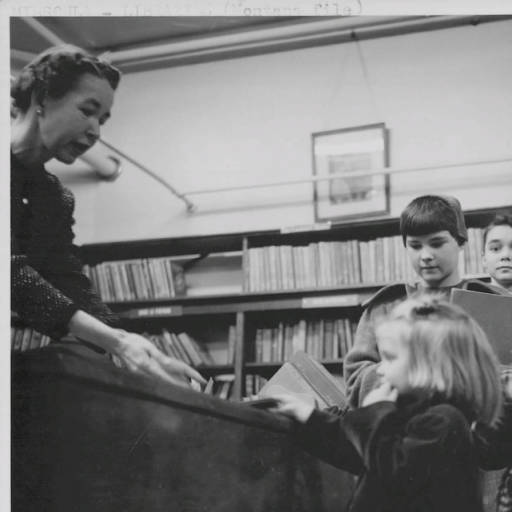
Though the archive photo below predates my childhood reading career by a few years, and the children's coats (and the date stamped on on the back of the photo) suggest a colder season, the Children's room was in the basement of a Carnegie grant-funded library building. That basement remained pleasantly cool throughout the summer!

Children and books at the Missoula Public Library (1956)
Image source: Montana Memory Project (https://goo.gl/QHH82m)

As I recall, there were story hours once a week, and children could get library cards as soon as they could sign their namesin cursive not printed script. However, the one book per child checkout limit proved irksome.

Once I'd gotten hooked on reading, one of my parents had to check out extra books to get us through the week. It wasn't too long before they had to persuade the librarian to let me check out books from the upper-elementary school stacks.

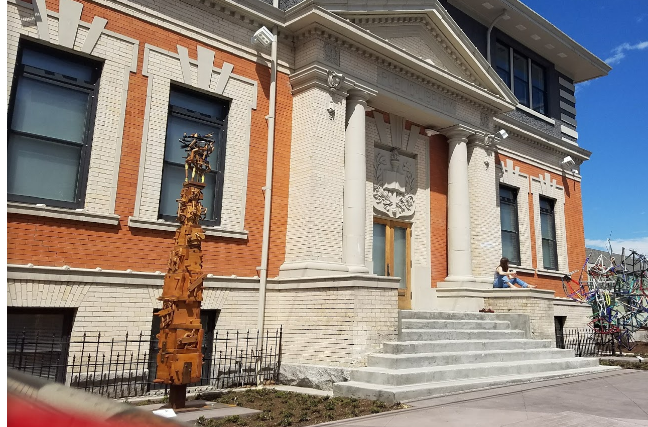
The old library building now is home to the Missoula Art Museum (http://www.missoulaartmuseum.org/), which offers a wide-range of art experiences for children (https://goo.gl/oQonjP).

Missoula Art Museum (Google).PNG
Missoula Art Museum, 335 N. Pattee St., Missoula, MT
Image source: Corey McClure (May 2017), Google Maps (https://goo.gl/VbEbea)


[295 words]

Tuesday, July 7, 2015

Shadowing for Improving Listening and Reading Skills (Fukushima & Lavin, 2013): A brief review

On June 13th, Mr. Taishi Kaneko (right) made his début as an emcee for guest speakers Mr. Hiroshi Fukushima (left) and Prof. Richard Lavin (center) at the PIGATE gathering in the KGU English Lounge. I hope we'll see and hear from them all again soon!
Mr. Kaneko introduced the guest speakers.

Along with a bit of historical and theoretical background, Mr. Fukushima and Prof. Lavin introduced two types of shadowing. The first focused learners' attention on the sounds of the target language, and the second focused on content–namely vocabulary, syntax (grammar) and meaning. 

PIGATE members had opportunities to try a little of both types. Then Mr. Fukushima reported on an on-going study to assess the effectiveness of shadowing relative to standardized test results. 


Prof. Takaki summed up the session.

Below are a couple of books on shadowing (Kadota, 2007, and Tamai, 2005) highlighted either in the presentation itself or in Prof. Takaki's summary. The other (Kadota, 2012), which I discovered today at Amazon, JP, appears to be a follow-up on the first.

  • Kadota, Shuuhei. (2007). シャドーイングと音読の科学 [shadouingu to ondoku no kagaku: the science of shadowing and reading aloud]. Tokyo, JP: Cosmopia.
  • Kadota, Shuuhei. (2012). シャドーイング・音読と英語習得の科学 [shadouingu, ondoku to eigo shutoku no kagaku: the science of shadowing, reading aloud and English acquisition]. Tokyo, JP: Cosmopia.
  • Tamai, Ken. (2005). リスニング指導法としてのシャドーイングの効果に関する研究 [risuningu shidouhou toshite no shadouingu no kouka ni kan suru kenkyuu: a study of the effects of shadowing as a method for teaching listening]. Tokyo, JP: Kazama Shobou.


Though there seemed to be a general consensus among audience members about the potential of shadowing for dedicated individual language learners, a question remained about how teachers might adopt and adapt such practices for general classroom instructional purposes.

If you have other key readings to suggest, other questions about shadowing, or suggestions regarding shadowing and classroom teaching practices in particular, please feel free to spell them out in comments on this post.