Pages

Showing posts with label listening. Show all posts

Wednesday, March 6, 2019

Yippee: A free continuing ed. cert. from edWeb.net!

You, too, can get a certificate like this from edWeb by watching and listening to the webinar recording: Error Correction: Tips and Techniques for Language Teachers.
Screenshot of PDF at ceu.edwebpd.net
(https://goo.gl/K19W66)

EdWeb is a free professional learning network. Its Browse and Search edWebinars pages listed 1564 webinars today (2019.03.06 [JST]) in, just a guess, hundreds of communities. 

Screenshot of Select Community menu


Please check it out, and leave comments on this post to let us know what you think.

[85 words]

Wednesday, October 24, 2018

Blended Learning and Technology Integration: What's the diff.?!?

In this seven and a half minute, video Jen Jonson (2014) explained and illustrated crucial characteristics of blended learning environments. If her delivery is too fast to follow, toggling on the auto-generated transcripts at YouTube, by clicking on "..." at the foot of the display frame, and reading along may help.


[65 words]

Saturday, August 19, 2017

Short report: A find-someone-who activity

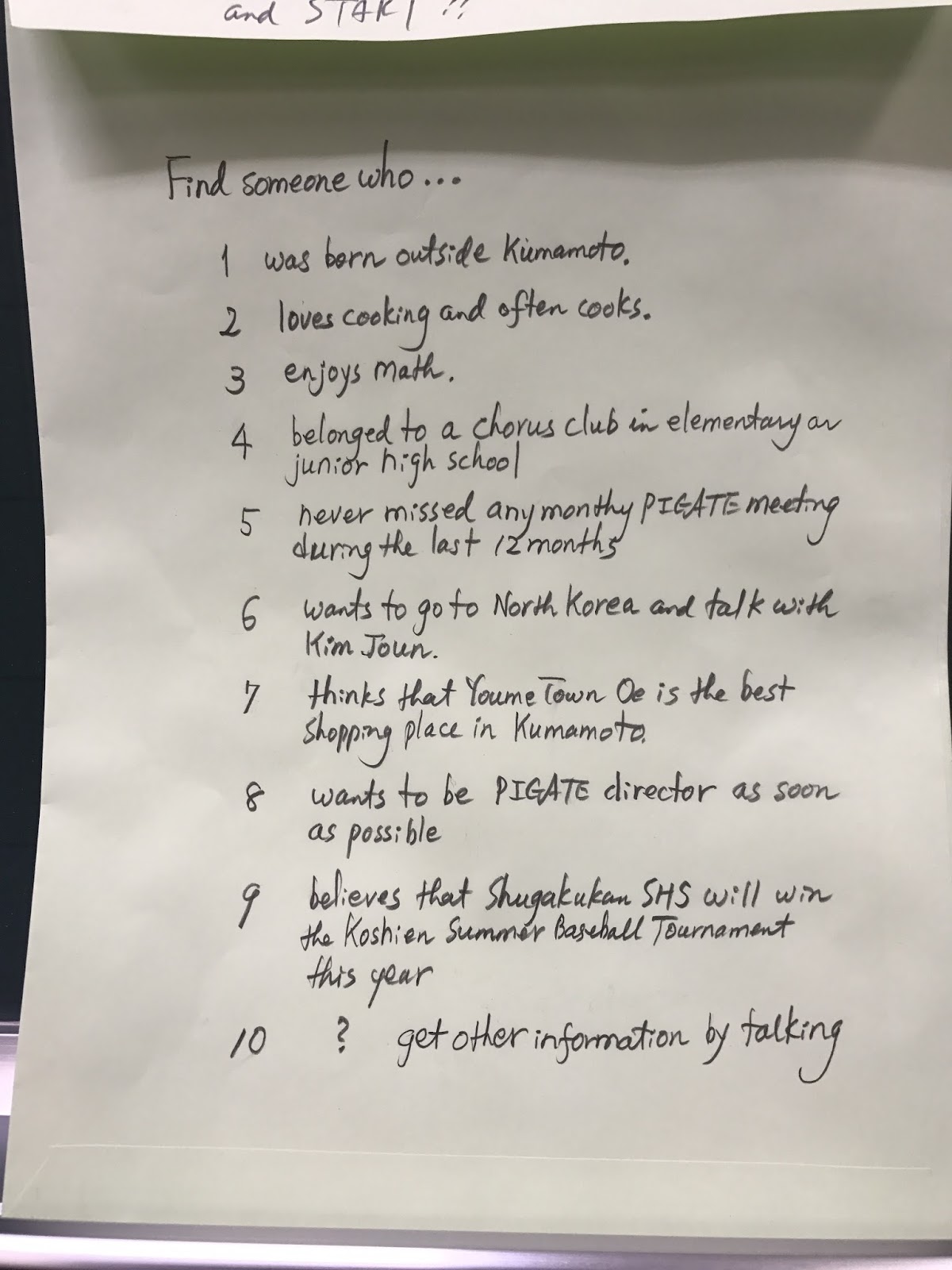
In the morning on Aug. 12, at PIGATE's Special Summer Session (SSS), Mr. Nobuyuki Takaki led a find-someone-who activity, which he introduced with "instruction checking questions" (The PIGATE Blog, 2017.06.01), and 10 interaction prompts that he'd printed on a large envelope (snapshot below).

2017-08-12 12.38.44.jpg
Find-someone-who interaction prompts for the SSS, 2017.08.12

Afterwards, when participants had shared their findings, and were reflecting on the activity in general, Mr. Takaki made a point of mentioning that it had been an integrated-skills activity, in which participants had listened, read, spoken, and written. When I feigned surprise that participants had used all four basic skills (listening, reading, speaking, and writing) during the activity, Mr. Takaki reiterated the point, so I'm quite certain that participants got it.

Paul Beaufait, The Prefectural University of Kumamoto
ボーフェ ポール, 公立大学法人熊本県立大学

Friday, June 30, 2017

2-Minute Tips: Smart Passwords (ConnectSafely.org)


ConnectSafely.org. (2016, October 25). 2-minute tips: Smart passwords [YouTube video]. Retrieved from https://youtu.be/e0ENHKyqRNY

Tuesday, May 16, 2017

Skidamarink: Super Simple Songs & Wee Sing YouTube videos

Skidamarink is one of the songs for young learners that Mr. Takaki introduced during the PIGATE gathering on ... [May] 13. Here are a couple videos of the song from the Super Simple Songs and Wee Sing YouTube channels.


If you use songs and gestures like that with young children or older learners, please shout out in comments on this post to let us know what your favorites are and how you use them.

[77 words]

Wednesday, March 2, 2016

Animal sounds galore!

Adaptation of Markham's Lexi the Poodle by pab (2016.03.02)
Some rights reserved (CC BY-SA 4.0)
A professor in Adelaide, Australia, Derek Abbott, has begun studying animal sounds as they would appear in comic strip speech balloons, according to posts in The Guardian and on the Mother Nature Network:
Both posts point to a website displaying Abbott's rather comprehensive collection of Animal Sounds, some transliterated into English from native language scripts. The MNN post also points to the video below featuring native speakers [of various languages] producing animal sounds.


Bow Wow Meow - Animal Sounds in Different Languages from Ke Nguyen on Vimeo.

Can you or, better yet, the learners you teach name all of the countries represented by flags in Nguyen's video?

[160 words {+3}]

Tuesday, July 7, 2015

Shadowing for Improving Listening and Reading Skills (Fukushima & Lavin, 2013): A brief review

On June 13th, Mr. Taishi Kaneko (right) made his début as an emcee for guest speakers Mr. Hiroshi Fukushima (left) and Prof. Richard Lavin (center) at the PIGATE gathering in the KGU English Lounge. I hope we'll see and hear from them all again soon!
Mr. Kaneko introduced the guest speakers.

Along with a bit of historical and theoretical background, Mr. Fukushima and Prof. Lavin introduced two types of shadowing. The first focused learners' attention on the sounds of the target language, and the second focused on content–namely vocabulary, syntax (grammar) and meaning. 

PIGATE members had opportunities to try a little of both types. Then Mr. Fukushima reported on an on-going study to assess the effectiveness of shadowing relative to standardized test results. 


Prof. Takaki summed up the session.

Below are a couple of books on shadowing (Kadota, 2007, and Tamai, 2005) highlighted either in the presentation itself or in Prof. Takaki's summary. The other (Kadota, 2012), which I discovered today at Amazon, JP, appears to be a follow-up on the first.

  • Kadota, Shuuhei. (2007). シャドーイングと音読の科学 [shadouingu to ondoku no kagaku: the science of shadowing and reading aloud]. Tokyo, JP: Cosmopia.
  • Kadota, Shuuhei. (2012). シャドーイング・音読と英語習得の科学 [shadouingu, ondoku to eigo shutoku no kagaku: the science of shadowing, reading aloud and English acquisition]. Tokyo, JP: Cosmopia.
  • Tamai, Ken. (2005). リスニング指導法としてのシャドーイングの効果に関する研究 [risuningu shidouhou toshite no shadouingu no kouka ni kan suru kenkyuu: a study of the effects of shadowing as a method for teaching listening]. Tokyo, JP: Kazama Shobou.


Though there seemed to be a general consensus among audience members about the potential of shadowing for dedicated individual language learners, a question remained about how teachers might adopt and adapt such practices for general classroom instructional purposes.

If you have other key readings to suggest, other questions about shadowing, or suggestions regarding shadowing and classroom teaching practices in particular, please feel free to spell them out in comments on this post.

Saturday, June 6, 2015

Coming June 13th: Fukushima and Lavin on Shadowing!

Shadowing is a practice of repeating the words of a model just after they are spoken. It is used quite widely in English education in Japan, where it first became popular after simultaneous interpreters found it beneficial in their training. It is considered important for beginners, because it is helpful in learning pronunciation. It is also considered useful for more advanced learners, because the time pressure can help learners increase the speed of their reactions.
In this presentation, Mr. Fukushima and Prof. Lavin outline the history and theoretical background of shadowing, and then look at its uses in improving language skills. Mr. Fukushima reports on a study he is conducting, in which he is using shadowing to try to improve his TOEIC® scores. 
(Presentation abstract, revised, 06 June 2015)

Mr. Fukushima (right, below) has a Master's degree from the University of New South Wales (Australia), and is working on a Doctoral degree in the Graduate School of Letters at the Prefectural University of Kumamoto (PUK). Prof. Lavin (left, below) teaches in the Department of English Language and Literature at the PUK.


Their presentation will take place in the English Lounge at Kumamoto Gakuen University (bldg. 1, 1st fl.). For a map showing the location and info. about getting there, please see the Meeting Location page.
[214 words]

Wednesday, April 22, 2015

Learning English the STELLAR way - Channel NewsAsia

Here's a bit of news about English teaching and learning in Singapore from 

I'd never heard of STELLAR before. How about you?

Are any of the activities the article mentions already in your teaching kit, or do they sound like they may be worth trying out (adopting and adapting)?

I'd love to read your thoughts about STELLAR practices in comments on this post!

[77 words]

Friday, February 13, 2015

Muppets Treasure Island - Cabin Fever

The Cabin Fever song from a 1996 Muppet movie is based on a classic adventure novel by Robert Louis Stevenson (Wikipedia, 2015, ¶1). The song has been burning inside my head for the past several days. So I decided to find a video clip that I could share here.


This song has been memorable not only because I love the Muppets, but also because the ship-board setting for the song in the video (Baker, 1996) contrasted so vividly with a snow-bound mountain cabin image that I've held from childhood adventures–including reading!

That is, my image related to the second definition of the noun (n.) cabin in WordNet 3.1, and the Muppet movie scene represented the first. As far as collocations go, "cabin fever" may not occur very frequently outside this song. Nevertheless, you may find it catching.

Doing a bit more browsing around the topic of cabin fever, I think I may have found a remedy, namely getting out and communing with nature (Berman, Jonides & Kaplan, 2008). Perhaps that's what I should be doing now, instead of planning another post!

References


Baker, Martin G., & Henson, Brian (Producers), & Henson, Brian (Director). (1996). Muppet treasure island [Motion picture]. United States: Jim Henson Productions.

Berman, M. G., Jonides, J., & Kaplan, S. (2008). The Cognitive Benefits of Interacting with Nature. Psychological Science, 19(12), 1207–1212. doi:10.1111/j.1467-9280.2008.02225.x

Wikipedia. (2015, February 11). Muppet Cabin Fever. Retrieved from http://en.wikipedia.org/wiki/Muppet_Treasure_Island


[241 words]