Pages

Showing posts with label lists. Show all posts

Friday, July 29, 2016

Social Media for You and Me? (summary)

Social Media for You and Me?
A reflective summary
by Paul Beaufait


First of all, I'd like to thank the directorate and membership of PIGATE for the opportunity that Mr. Hirotaka Terada and I had to make an extended presentation about social media for PIGATE, at Kumamoto Gakuen University (KGU) on June 11th, 2016. It was encouraging to see how determined the director, Mr. Nobuyuki Takaki, and other members of the group were to resume PIGATE-style grassroots teacher development activities, in spite of severe consequences of earthquakes in Kumamoto. I'd like to extend special thanks to Prof. Joseph Tomei for making arrangements for the PIGATE group to meet at KGU in both June and July.


In the aftermath of the tremors, which necessitated cancellation of the PIGATE gathering in May, it was a challenge to plan and develop contributions for a joint presentation entirely at a distance. Though Terada and I had exchanged a few ideas face-to-face after the meeting in April, we depended completely upon internet communication technology (ICT) from then until we met again at KGU a few minutes before the June meeting began. So this had become an opportunity to both explore and employ handy and useful online media in collaborative presentation development.


Beyond 1) basic email service (Gmail) underpinning our initial contacts and endeavours, 2) a social networking service that both presenters use regularly (LINE), and 3) a shared Google presentation around and on which to collaborate; possible social media upon which to focus our presentation were virtually uncountable (see: The Conversation Prism 4, 2014, below).
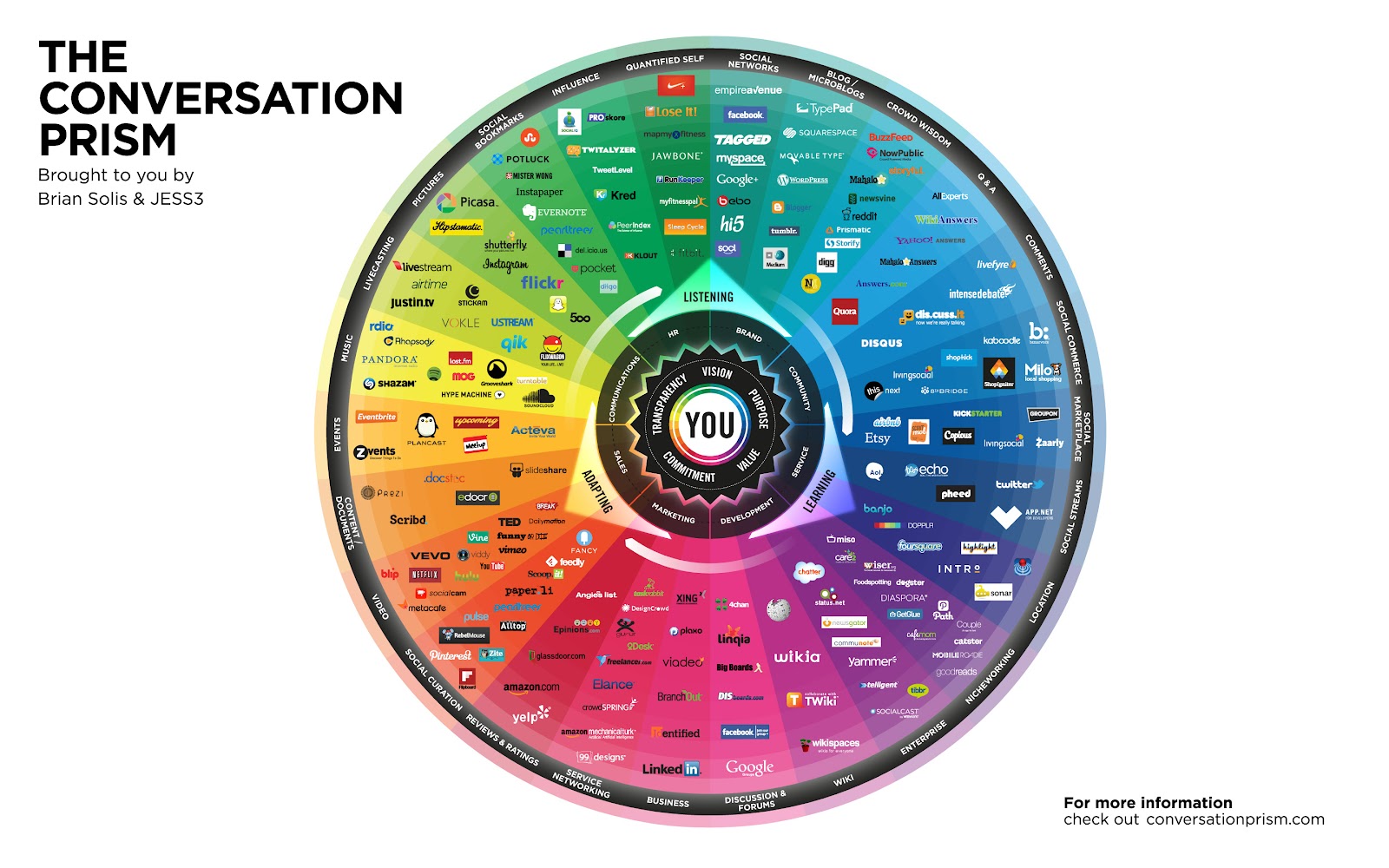
JESS3_BrianSolis_ConversationPrism4_WEB_2880x1800.jpg


Our shared Google presentation, now public on the PIGATE Blog (2016.06.12), included pretest and posttest items to assess audience members' knowledge and beliefs with regard to the nature of social media and uses of them. Pretest responses, the presenters hoped, would lay a foundation for a working definition of social media. Initial discussion of personal and professional purposes rounded out common characteristics of social media that Obar & Wildman (2015) had identified, namely:


  • Internet-based applications (apps),
  • User-generated content,
  • User- and group-specific profiles for apps or websites, and
  • Networking services facilitating connections amongst users and groups.


As had a couple of PIGATE members who'd responded to the Monthly Special prompt for the Dec. 2015 newsletter (No. 267, 2016.01.01, pp. 27-28, https://goo.gl/mQ6Dio), Terada expressed a preference for online communication via LINE (Free calls and messages). So the presenters used LINE for Voice-over Internet Protocol (VoiP, https://goo.gl/D4YMBG) calls to talk through research and development of their presentation, as well as for text messages to arrange and follow-up on those VoIP calls.


Terada's findings reflected extended discussions with twenty classmates and friends, who'd used mainly LINE, Facebook, and Twitter, and to a lesser extent Instagram. Those discussions explored various merits and demerits of social networking service (SNS) use, as well as trouble that users or their friends had encountered. In a nutshell, Terada found such SNSs useful for one-way distribution of information, yet problematic when responses were desirable or necessary.


Beaufait pointed out benefits of social media use that the Online Learning Consortium (2016) had reported for online instructional programs, in particular potential for:


  1. Learner engagement (and retention),
  2. Instructional effectiveness–achieving desired learning outcomes, and
  3. Provisions of career and educational support services.


Beaufait also called attention to passive (automatically collected) and active (individually produced) data found in so-called digital footprints, or virtual representations of our real-life selves (Oglethorpe, 2012). Such footprints may work either against or for job-seekers, professional program applicants, or students in general. Beaufait noted that, in the eyes of some schools, "A Google search result is your portfolio" (Leigh Blackall, Teaching and learning online [TALO] Google group mailing list, 2016.06.01, emphasis added).


Discussion periods throughout the presentation explored numerous questions–many more than possible to answer in-session to everyone's satisfaction, for example:


  • What's social about social media–if people use them merely as tools for broadcasting personal information, rather than for facilitating and promoting educational exchanges or socially responsible endeavours;
  • What changes may be taking place in attitudes and practices with respect to privacy and control of personal information in highly-interconnected online communities, groups, and networks; and
  • What can we as educators and language learners do to maximize benefits and minimize risks of social media use, for both personal and professional purposes, as well as for students–young ones in particular, whom we may serve as trail-breakers, role-models, guides, or coaches?


Among the references for our presentation in the slideshow on the PIGATE Blog, I'd like to highlight Davis (2015) as the source for Web-guides for teachers (currently slide 54), and to double up on Couros (2011, 2013, 2016a, & 2016b). George Couros (@George Couros, https://goo.gl/0c4J1T) not only granted permission for use of a custom graphic in animation of Bringing community into classrooms (currently slide 58), but also has provided numerous examples and suggestions of ways to use Twitter for professional development purposes.


In wrapping up here, I'd like to encourage everyone, social media users and non-users alike, to review public pre- and post-session tweets here (https://goo.gl/s3K1lu). I also hope you'll take active parts in on-going and future conversations and explorations of potential uses for social media in additional language and professional network development–for both learning and teaching purposes.


Please allow me to close with thanks to all who took part in the June gathering, and a reminder from our presentation (Social media sufficiency, currently slide 62):


"[C]ollaborative conversations alone are often not enough to promote teacher learning and change. Teachers must try complex innovations, and reflect upon these implementations in order to extract from experience the knowledge that leads to improved teaching."
(Alderton, Brunsell, & Bariexca, 2011)


Paul Beaufait ボーフェ ポール
Prefectural University of Kumamoto 熊本県立大学

Version 20160729b
This is a revised version of an article that
originally appeared in PIGATE Newsletter 272 (2016.07.04).
[989 words]


Wednesday, April 6, 2016

Flashback: Introducing Hap Palmer to Japan (Yoneoka, 2015.01.09)

This post is a follow on to Prof. Judy Yoneoka's guest speaker presentation last January (2016.01.09). The converted slideshow below includes active links to numerous musical resources that she used to demonstrate classroom activities.

As a newsletter write-up explained:
[She] is a professor in the Department of English and American studies at Kumamoto Gakuen University. Her major research theme is world Englishes.
(PIGATE Newsletter, 268, p. 4)


Introducing Hap Palmer to Japan (Yoneoka, 2015.01.09 [converted])


A few additional musical resources are listed in a previous post, along with a call for more resource suggestions: Music for children: Online resources (2016.01.22).

[100 words]

Wednesday, March 2, 2016

Animal sounds galore!

Adaptation of Markham's Lexi the Poodle by pab (2016.03.02)
Some rights reserved (CC BY-SA 4.0)
A professor in Adelaide, Australia, Derek Abbott, has begun studying animal sounds as they would appear in comic strip speech balloons, according to posts in The Guardian and on the Mother Nature Network:
Both posts point to a website displaying Abbott's rather comprehensive collection of Animal Sounds, some transliterated into English from native language scripts. The MNN post also points to the video below featuring native speakers [of various languages] producing animal sounds.


Bow Wow Meow - Animal Sounds in Different Languages from Ke Nguyen on Vimeo.

Can you or, better yet, the learners you teach name all of the countries represented by flags in Nguyen's video?

[160 words {+3}]

Thursday, February 18, 2016

PIGATE in Cyberspace: Comments for working outline, please!

The purpose of this post is to call for comments, questions, and suggestions regarding another work in progress. 

I'd like to get feedback from PIGATE members, old and new, on a working outline for a research paper in preparation for the summer 2016 issue of the PIGATE working papers (紀要 [kiyou]).


PIGATE in Cyberspace [working title]
An environmental scan of Internet communication technology (ICT) uses, challenges, and potential for collective grassroots teacher development [working sub-title]

Below is the body of the working outline. Most of all I'd appreciate suggestions of new sections or subsections to add in order to represent various aspects of ICT in use that I may have overlooked so far.


...
...


Please feel free either to post your comments, questions, or suggestions in comments attached to this post, or to voice your ideas in person the next time we meet (12 March 2016?).

Likewise, if you'd like to get a personal look at details as they appear and develop in the paper itself, please do not hesitate to ask for access to the work in progress.

[272 words]

Friday, January 22, 2016

Music for children: Online resources

Image source: Pixabay
Creative Commons CC0

At present, this post is a work in progress inspired by Prof. Yoneoka's presentation of Hap Palmer's music for children at the PIGATE gathering 9 January 2016. 

The songs Prof. Yoneoka played and the activities she led to accompany them reminded me of another musician I'd met years ago in British Columbia, Canada, named Matt Maxwell.

Sort of like Santa, I'm making a list and checking it twice. It would be a pleasure to hear of other resources like these:


...

If you know of any similar resources, please spell them out in comments on this post, and I'll be happy to look them up and add them to this growing list.

Tuesday, December 15, 2015

The PIGATE Blog and kindred sites–rites of passage

It has been a remarkable and stimulating yet tumultuous year.

The JALT NanKyu Chapter's Blogger blog passed away on Dec. 5th at the early age of one year, two months, and 14 published posts. So I've removed its RSS feed from The PIGATE Blog sidebar and replaced it with a new RSS feed from JALT NanKyu's recently established website

That removal followed on the heels of a similar removal of the disused NanKyu Chapter's Google calendar from The PIGATE Blog Calendar of Events page display and its replacement with a generic Japanese holiday calendar feed.

Previously invisible in The PIGATE Blog sidebar, but now growing slowly, is a list of cross-links to Other PIGATE Favo(u)rites. There now are two links there to sites from which feeds don't seem to be available (8-(:
  1. PIGATE on Facebook (a closed group), and
  2. JALT NanKyu Chapter on Facebook (no longer a closed group).
If you have any other favo(u)rite sites that you'd like to share publicly on The PIGATE Blog, either as RSS feeds or cross-links, please shout them out in comments [on this post]–OR, better yet, volunteer to lend a hand in fostering The PIGATE Blog, which was a year and 33 published posts old on Sunday, Dec. 13!

[206 {+3} words]

Monday, March 2, 2015

A Blast from the Past: Mr. Waterman's Materials from 10 Jan. 2015

PIGATE members who attended the January workshop with Mr. Waterman
  • On adaptations from published board games, 
  • Emceed by Ms. Sakada at KGU

may already have received copies of his materials. That is, if they left their email addresses on the list that he'd prepared for requests for copies.

Worry not! For anyone who:
  1. Wasn't there in January to sign up, 
  2. Didn't get on Mr. Waterman's sign-up sheet, or 
  3. Wants the new improved version;
Mr. Waterman and I have prepared a Google document from his originals that you all can view via these links:

If you have any concerns or questions about access to those materials or how you may use them, please spell them out in comments on this post. Thanks!

[138 words]

Sunday, February 15, 2015

Grammar Monster

Looking for a site to point out to a student who had waited almost a year to inform me that (s)he didn't know what "title case" meant, I found Grammar Monster with a quick web search. Interestingly enough, the lesson page topped the glossary page for title case in the search and in ease of understanding.

The main entry began with a Quick Answer, and then a brief explanation that used a few words like articles and prepositions. Learners at first might want but not need explanations, because the both the lesson and glossary pages for title case gave examples of those parts of speech. 

The explanation on the lesson page could be simpler than it is, so I sent these suggestions to the site owner: "When writing a name or a title, it is . . . common . . . to . . . use capital letters [only] to start the . . . [main] words." (2015.02.15). Following the brief explanation, there were plenty of annotated examples of titles in title case–plus more notes in a sidebar to the right.

The site itself features five pages in a navigation bar on the home page:
  1. Common Grammar Errors
  2. Easily Confused Words
  3. Free Grammar Tests,
  4. Grammatical Terms
  5. Punctuation Lessons.
Grammar Monster also has a search page with cross-links to the most popular pages on site. So the site may be quite useful. That is, if you know what to look for, and if you are able to ignore the ads here and there, and the video clips playing over and over in the side bar.


[271 words]