Pages

Showing posts with label reports. Show all posts

Wednesday, October 2, 2019

Online activities and opportunities: Work in progress

The short (16 slide) presentation embedded in this blog post represents on-going endeavours mainly to recover from a massive setback in online resource curation. In a nutshell:
This presentation provides snapshots of an individual teacher's recent and ongoing professional development endeavours. It reflects problems of ICT use, mainly discontinuation of a free service for educators, and outlines strategies for addressing them with collaborative partners, tools, and venues of choice. It supplements a working paper submitted to PIGATE.
(Abstract, slide 2)


If you have comments or questions with regard either to the content of slides in that short presentation or the gist of the working paper (Beaufait, 2019) submitted to PIGATE prior to its Annual General Meeting last month (2019.09.14), please feel free to spell them out in threadable comments on this post.

Reference


Beaufait, P. (2019a). Reflection in action: An unavoidable IT transition. PIGATE eigo jugyou gaku kenkyuu-kai kiyou, 26 [English language teaching action research group working papers, issue 26], 32-42.

[164 words]

Saturday, August 19, 2017

Short report: A find-someone-who activity

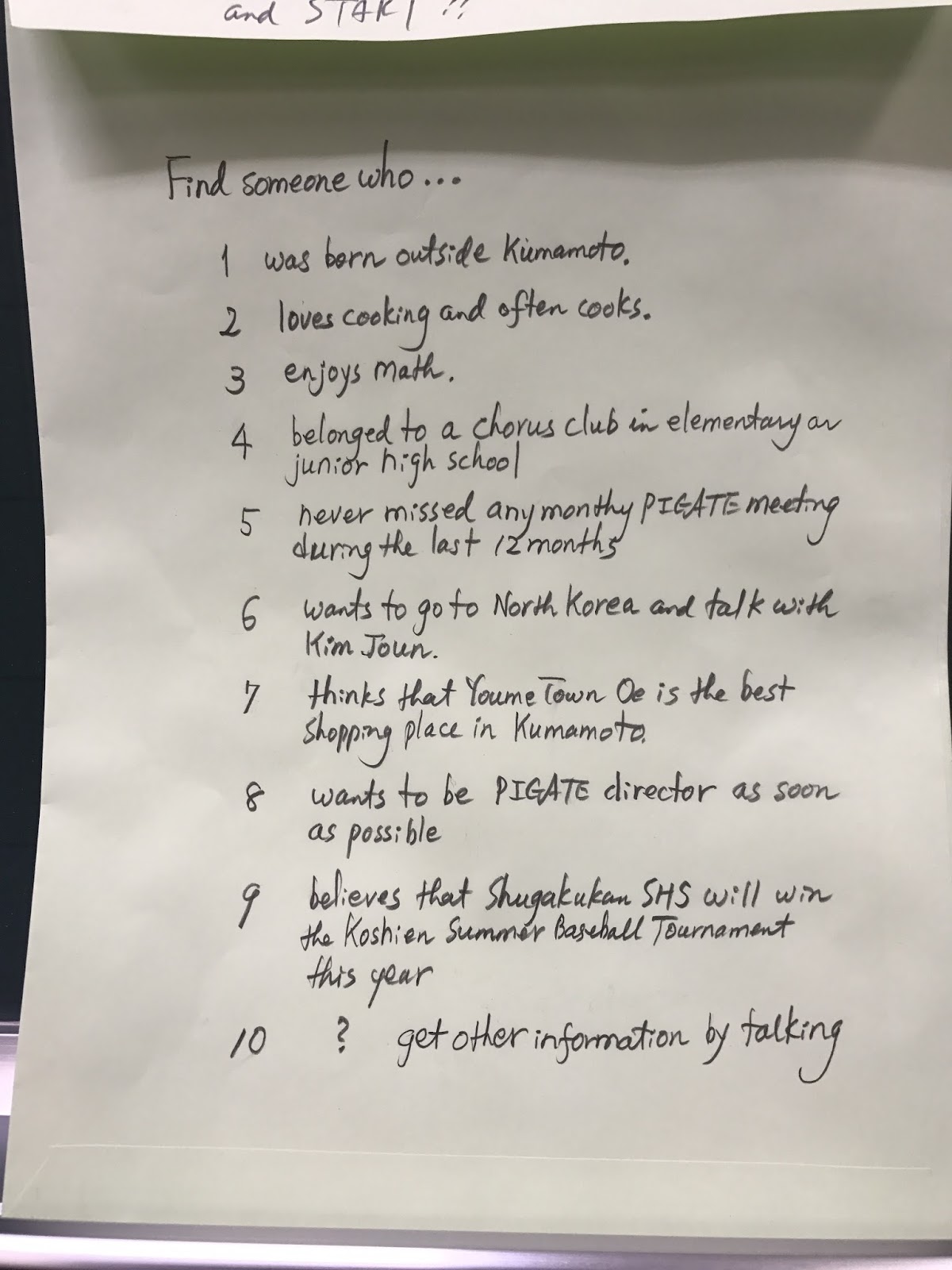
In the morning on Aug. 12, at PIGATE's Special Summer Session (SSS), Mr. Nobuyuki Takaki led a find-someone-who activity, which he introduced with "instruction checking questions" (The PIGATE Blog, 2017.06.01), and 10 interaction prompts that he'd printed on a large envelope (snapshot below).

2017-08-12 12.38.44.jpg
Find-someone-who interaction prompts for the SSS, 2017.08.12

Afterwards, when participants had shared their findings, and were reflecting on the activity in general, Mr. Takaki made a point of mentioning that it had been an integrated-skills activity, in which participants had listened, read, spoken, and written. When I feigned surprise that participants had used all four basic skills (listening, reading, speaking, and writing) during the activity, Mr. Takaki reiterated the point, so I'm quite certain that participants got it.

Paul Beaufait, The Prefectural University of Kumamoto
ボーフェ ポール, 公立大学法人熊本県立大学