Pages

Showing posts with label events. Show all posts

Tuesday, March 24, 2020

PIGATE's first entirely online gathering

This post showcases slides from PIGATE's March gathering (2020.03.14). Previews of slide-building in progress were available the week leading up to PIGATE's first entirely online program. 


The gathering took place in a Zoom meeting room with screen sharing from remote presenters. 


Amplifications and revisions of slides continued afterwards. 

Follow-up questions, reflections, and suggestions are welcome in comments on this blog post.


Except as otherwise noted, slides in that compilation are licensed under a 
Creative Commons Attribution-NonCommercial-ShareAlike 4.0 
International License (CC BY-NC-SA 4.0). 

Please attribute adoptions or derivations [of the slides] to The PIGATE 英語授業学研究会 2020.03.14.

[105 [+3] words]

Wednesday, January 22, 2020

Dr. Morrow's presentations from December 2019

This post showcases two presentations that Dr. Jeffrey S. Morrow made at the PIGATE gathering on December 14, 2019, on:

  1. Keys to Successful Student Motivation; &
  2. Successful Pronunciation Teaching.
These are for attendees to review as well as for the perusal of PIGATE members who had other commitments last month.


If you have questions or suggestions regarding either of those presentations, please feel free to:
  • Post them in comments on this blog post; 
  • Send them in messages to the PIGATE Google Group;
  • Voice them at an upcoming PIGATE gathering (Calendar of Events); or 
  • Address them directly to Dr. Morrow (contact info. at ends of slide shows).

Except as otherwise noted, each of those presentations is licensed under a 
Creative Commons Attribution-NonCommercial-ShareAlike 4.0 International License:
CC BY-NC-SA 4.0.
Please attribute them to Dr. Jeffrey S. Morrow.
[138 words]

Monday, August 5, 2019

Sneak preview of PIGATE's Special Summer Session


PIGATE's Special Summer Session (SSS)


Tentative schedule (as of 2019.07.05)

09:30 Preparation and sign-in (30 min.)
10:00 Opening remarks (10 min.): Paul Beaufait
10:10 IPS, Part 1 (45 min.): English pronunciation challenges for English teachers
10:55 Break (10 min.)
11:05 IPS, Part 2 (45 min): Tactics for teaching oral expression
11:50 Lunchtime (60 min.)
12:50 CPS, Part 1 (45 min.): Favorite picture books and stories to share
13:35 _Kitemiran_¹ and _shitemiran_² sharing time (15 min.)
13:50 CPS, Part 2 (45 min.): Experience and tips for learning and teaching with stories
14:35 Break (15 min.)
14:50 Working Papers (_kiyou_) workshop (45 min.):
Reflections, projections, & progress reports;
Preparation and collaboration time; &
Submission guidelines & deadlines.
15:35 Session summary: Mr. Nobuyuki Takaki (15 min.)
15:50 Closing remarks (10 min.)
Membership matters
Newsletter contributions
Other announcements:
Annual General Meeting (AGM), 2019.09.14
Other
16:00 Clean-up (10 min.)
16:10  Steering committee meeting (20 min.)
Presenters and PIGATE members are welcome to attend the committee meeting!
____________________
¹ Why don't you come and see this?
² Why don't you try this and see?


If you would like to take part in this month's session, or to join PIGATE, please fill out one of our short online info. collection forms (https://goo.gl/Hpe9pd). 

Thursday, May 30, 2019

PIGATE gathering, 2019.06.08

PIGATE's June 2019 session


This month's highlights: Guest Speaker Series (GSS)


Active Learning from Theory to Practice


Dr. Fumi Takegami

Faculty of Letters
The Prefectural University of Kumamoto


Prof. Terry Laskowski

Faculty of Letters, Kumamoto University


Date & time

Saturday, June 8, 2019; 13:30–16:30

  • Doors open at 13:00!

Venue

Seminar room 10, 5th floor, Faculty of Administrative Studies office wing; 
Prefectural University of Kumamoto (PUK)


About the presenters and the program

Fumi Takegami has extensive teaching experience in schools ranging from elementary to secondary levels, mostly at high school. She is now teaching in the Faculty of Letters at the PUK. Terry Laskowski also has extensive teaching experience, in his case at university. He now teaches in the Faculty of Letters at Kumamoto University.

Together Terry and Fumi will talk about the relationship between theory and practice in teaching.  Linking theory to practice helps teachers to better understand why they do what they do in their classrooms. Having this knowledge will better inform teachers regarding their instructional practices. 

During their workshop session, Fumi and Terry will talk about learning theories going from behaviorism to social constructivism and complementary teaching methods. They will focus in particular on social constructivism and related teaching methods and techniques. 

Participants will take part in classroom activities. Through active involvement, i.e., active learning, participants will understand the purpose of the activities by experiencing them themselves. They can expect to take part in a jigsaw activity and a task-based problem solving activity.


Let us know you're coming!

If you would like to take part in this month's session, or to join PIGATE, please fill out one of our short online info. collection forms (https://goo.gl/Hpe9pd). 

  • Thank you!


Monday, September 3, 2018

Coming soon: Self-determination theory—for young learners and the young at heart!


Creating and implementing interactive tasks based on self-determination theory—for young learners and the young at heart!

By David Ockert, Toyo University


David Ockert’s teaching interests are in critical thinking, reading comprehension, and academic writing. He does research on the influence of technology on affective variables (motivation, confidence, anxiety, and willingness to communicate). 

David also enjoys creative lesson planning for communicative purposes, using a task-based language teaching (TBLT) approach via the three pillars of self-determination theory [SDT]: competence (mastery), relatedness, and autonomy. 


For this presentation, David will focus on self-determination theory-based EFL motives interconnected with competence, relatedness, and autonomy. He will show how all three can be incorporated easily into any level of pedagogy, with a focus on the junior high school level in Japan.

[UPDATE, 2018.09.10: This presentation will be a participatory event with very little lecture. David will lead participants through hands-on tasks, with evaluation of each afterwards, to provide a real-world experience of how and why SDT-based lessons work.]


Date & time

Saturday, September 15, 2018; 13:30–16:30

Venue

Seminar room 10, Faculty of Administrative Studies office wing, Prefectural University of Kumamoto (PUK): Please see PIGATE Meeting Locations (https://goo.gl/h5DgbP) for details.

Attendance plans

Hoping or planning to attend? Please let us know by filling out an attendance form: 
If you'd also like to attend an informal networking event afterwards (tentatively 18:30–20:30), please ... add, "Post-function: Yes!" (without quotation marks) along with your email address as Additional info. at the end of the form [2018.09.13: ... ask Paul in person on Saturday whether a seat is still available].
[227 {+ 50} words]

Tuesday, March 27, 2018

ASCD Express 9.02 - The Why, What, and When of Assessment

ASCD Express 9.02 - The Why, What, and When of Assessment (Tomlinson & Moon, 2013b)

That newsletter article caught my eye this morning in a list of website bookmarks after discussion at an English Café gathering yesterday, in which participants ... considered ... [among other topics]: 
  • Assessment practices in elementary school English-as-an-additional language learning activities slated to become mandatory coursework in the next few years (GU, n.d), and 
  • Roles of assistant or partner classroom teachers in occasional or routine team-teaching. 

The article is an adaptation of Tomlinson and Moon (2013a, pp. 19-21), in which the authors described assessment of, for, and as elements of differentiated instructionTomlinson and Moon argued for assessments to identify differences in: 
  • Individual learners' readiness to learn, 
  • Their individual interests or passions, and 
  • The learning modalities that individuals prefer (2013b, What to Assess, ¶1).

Tomlinson and Moon also outlined various types of assessment to use before, during, and after instructional units, namely: 
  • Pre-instructional assessments,
  • Formative or ongoing assessments, and
  • Summative assessments (2013b, When to Assess, ¶1).

The article concluded with examples of, and purposes for, combinations of formal and informal assessments. Regarding informal assessments in particular, Tomlinson and Moon asserted:
Informal assessments are useful in giving a teacher a sense of what makes a student tick, providing a big-picture look at how the class as a whole seems to be faring at a given moment, and amassing a growing sense of how specific students work in particular contexts (2013b, When to Assess, ¶2).
The first few examples of informal assessments that Tomlinson and Moon mentioned in their article resonated with remarks that the English Café convener made yesterday with regard to what a team teacher could do when not directly involved in instructional activities.


References


General Union [GU]. (n.d.). MEXT's 2018/2020 "New Course Of Study In Foreign Language Education" Plan. [Retrieved 27 March 2018 from] https://goo.gl/sBjXpo

Tomlinson, C. A., & Moon, T. R. (2013a). Assessment and Student Success in a Differentiated Classroom. Alexandria, VA: Association for Supervision and Curriculum Development.

Tomlinson, C. A., & Moon, T. R. (2013b). The why, what, and when of assessment. Assessment and Differentiation, 9(2). http://www.ascd.org/ascd-express/vol9/902-tomlinson.aspx

[365 [- 2 + 8] words]

Tuesday, September 12, 2017

ICT to-dos: Map and plans

The mind map in this post points out locations of online endeavours by and for members of a grassroots language teacher development group, for various language and professional development purposes. 

Though the map itself is far from comprehensive at present, it does include both links to venues and [plenty of] to-dos (tasks with or without checkboxes) planned or envisioned in order to consolidate, extend, and facilitate ICT use by group members. 

One such purpose involves collaborative creation and publication of information to promote face-to-face group events. Others reflect collective documentation of activities, maintenance of archives, and sharing and showcasing of professional development resources. 

Tasks may be one-off, on-going, or periodic (recurring monthly or annually). Green arrows indicate connections between various tasks and other tasks or venues.

Source: Mindmeister.com

[143 {+ 2 (- 3 )} words]

Wednesday, August 23, 2017

La grotte de Lascaux (Lascaux cave): Daizaifu exhibition

A special exhibition on the Lascaux Cave will be at the Kyushu National Museum in Daizaifu (Fukuoka, JP) until Sunday, September 3, 2017. If you have time to spare, this is an exhibit not to miss!

Lascaux: Cave Paintings of the Ice Age
(2017.08.22 ticket stub)

For an in-depth, audio-visual and text presentation of the cave, its history, and its preservation, please visit the French Ministère de la Culture website:


The site directory and language options (flag icons) appear if you mouse-over the left margin.

[95 words]

Saturday, August 19, 2017

Short report: A find-someone-who activity

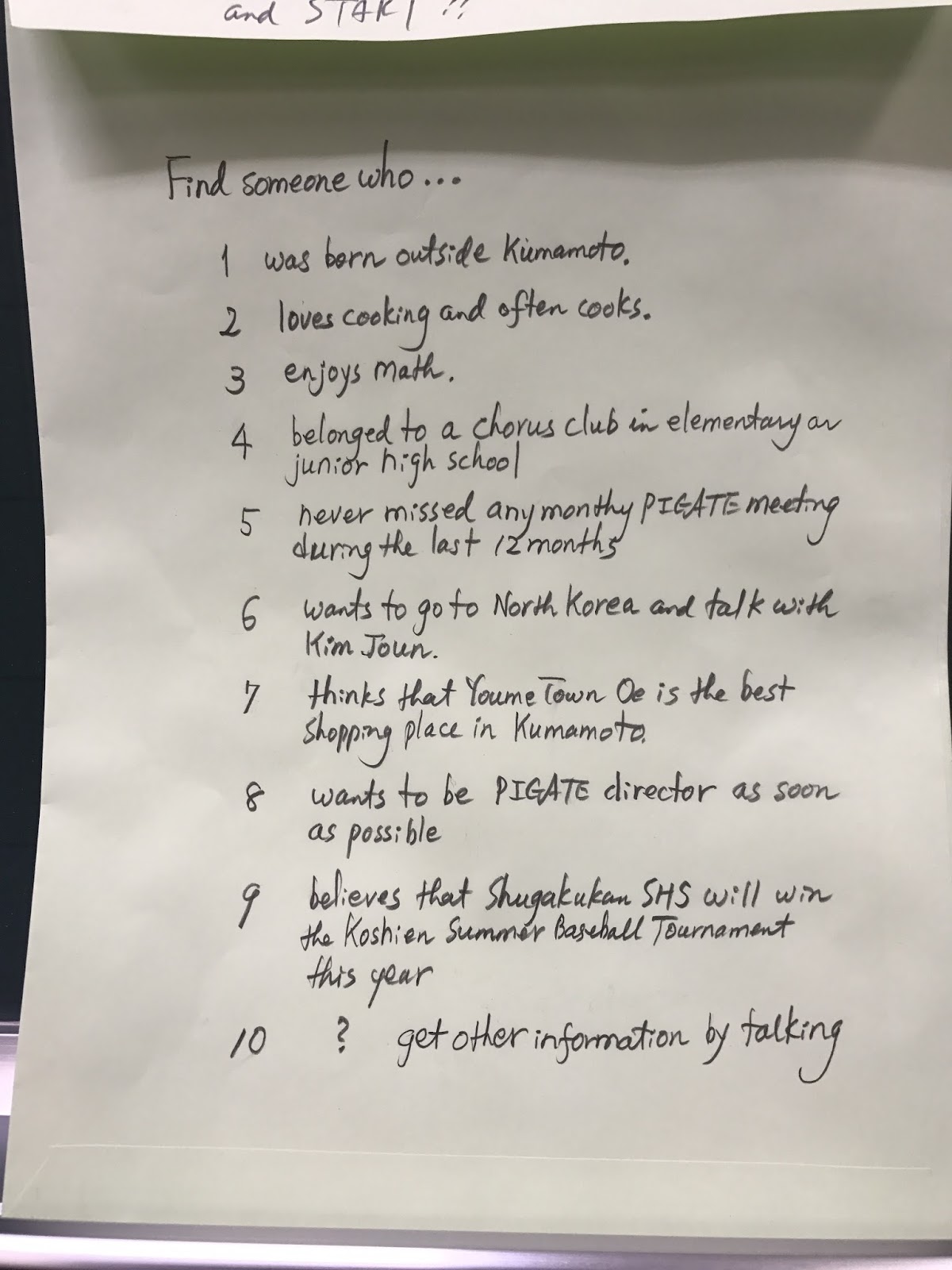
In the morning on Aug. 12, at PIGATE's Special Summer Session (SSS), Mr. Nobuyuki Takaki led a find-someone-who activity, which he introduced with "instruction checking questions" (The PIGATE Blog, 2017.06.01), and 10 interaction prompts that he'd printed on a large envelope (snapshot below).

2017-08-12 12.38.44.jpg
Find-someone-who interaction prompts for the SSS, 2017.08.12

Afterwards, when participants had shared their findings, and were reflecting on the activity in general, Mr. Takaki made a point of mentioning that it had been an integrated-skills activity, in which participants had listened, read, spoken, and written. When I feigned surprise that participants had used all four basic skills (listening, reading, speaking, and writing) during the activity, Mr. Takaki reiterated the point, so I'm quite certain that participants got it.

Paul Beaufait, The Prefectural University of Kumamoto
ボーフェ ポール, 公立大学法人熊本県立大学

Thursday, August 10, 2017

PIGATE's Special Summer Session (2017.08.12)

This post provides a preview of slides in the works for Saturday's big event. It also includes a Tweet feed display for the Twitter hashtag #higopigateSSS.


Tweet about it: #higopigateSSS


Relevant comments and questions are more than welcome!
[88 words]

Sunday, April 16, 2017

An Online Teacher Summit and SNSs


+ +


During an Online Teacher Summit (https://onlineteachersummit.com, April 2nd through 9th, Central Time in the U.S.) that I attended to the extent possible given the time difference and a busy beginning of semester here in Kumamoto, I took a couple of small steps to broaden my online base; I added Instagram and Pinterest to my repertoire:


Though I've begun networking with Instagram, it isn't immediately clear what extra-social (i.e., educational) purposes it may serve. Yet with Pinterest I have created a few boards with help from suggestions that Pinterest sends, via email and notifications, of related pins to consider for new boards such as:


While most of the networking and sharing for the Online Teacher Summit took place via Facebook, various online meeting spaces, and video playback sites, my LinkedIn and Twitter networks have been growing simultaneously.

Wednesday, August 10, 2016

PIGATE's Special Summer Session: August 13, 2016

This post ... includes ... a slideshow introducing PIGATE's Special Summer Session [SSS] at the Prefectural University of Kumamoto, August 13, 2016. [It also may display recent earmarked Tweets about or related to the SSS.]


You can find the working agenda for this year's SSS in the PIGATE calendar on the Calendar of Events page of The PIGATE Blog. Directions to the SSS venue are on the Meeting Location page.

Tweet about it: #higopigateSSS


[74 words]

PS: Here are a few snapshots from the SSSession.


Thanks to Misato for rounding up delicious boxed lunches from RanTen in Mashiki-machi!


[+ 23 words]

Friday, July 29, 2016

Social Media for You and Me? (summary)

Social Media for You and Me?
A reflective summary
by Paul Beaufait


First of all, I'd like to thank the directorate and membership of PIGATE for the opportunity that Mr. Hirotaka Terada and I had to make an extended presentation about social media for PIGATE, at Kumamoto Gakuen University (KGU) on June 11th, 2016. It was encouraging to see how determined the director, Mr. Nobuyuki Takaki, and other members of the group were to resume PIGATE-style grassroots teacher development activities, in spite of severe consequences of earthquakes in Kumamoto. I'd like to extend special thanks to Prof. Joseph Tomei for making arrangements for the PIGATE group to meet at KGU in both June and July.


In the aftermath of the tremors, which necessitated cancellation of the PIGATE gathering in May, it was a challenge to plan and develop contributions for a joint presentation entirely at a distance. Though Terada and I had exchanged a few ideas face-to-face after the meeting in April, we depended completely upon internet communication technology (ICT) from then until we met again at KGU a few minutes before the June meeting began. So this had become an opportunity to both explore and employ handy and useful online media in collaborative presentation development.


Beyond 1) basic email service (Gmail) underpinning our initial contacts and endeavours, 2) a social networking service that both presenters use regularly (LINE), and 3) a shared Google presentation around and on which to collaborate; possible social media upon which to focus our presentation were virtually uncountable (see: The Conversation Prism 4, 2014, below).
JESS3_BrianSolis_ConversationPrism4_WEB_2880x1800.jpg


Our shared Google presentation, now public on the PIGATE Blog (2016.06.12), included pretest and posttest items to assess audience members' knowledge and beliefs with regard to the nature of social media and uses of them. Pretest responses, the presenters hoped, would lay a foundation for a working definition of social media. Initial discussion of personal and professional purposes rounded out common characteristics of social media that Obar & Wildman (2015) had identified, namely:


  • Internet-based applications (apps),
  • User-generated content,
  • User- and group-specific profiles for apps or websites, and
  • Networking services facilitating connections amongst users and groups.


As had a couple of PIGATE members who'd responded to the Monthly Special prompt for the Dec. 2015 newsletter (No. 267, 2016.01.01, pp. 27-28, https://goo.gl/mQ6Dio), Terada expressed a preference for online communication via LINE (Free calls and messages). So the presenters used LINE for Voice-over Internet Protocol (VoiP, https://goo.gl/D4YMBG) calls to talk through research and development of their presentation, as well as for text messages to arrange and follow-up on those VoIP calls.


Terada's findings reflected extended discussions with twenty classmates and friends, who'd used mainly LINE, Facebook, and Twitter, and to a lesser extent Instagram. Those discussions explored various merits and demerits of social networking service (SNS) use, as well as trouble that users or their friends had encountered. In a nutshell, Terada found such SNSs useful for one-way distribution of information, yet problematic when responses were desirable or necessary.


Beaufait pointed out benefits of social media use that the Online Learning Consortium (2016) had reported for online instructional programs, in particular potential for:


  1. Learner engagement (and retention),
  2. Instructional effectiveness–achieving desired learning outcomes, and
  3. Provisions of career and educational support services.


Beaufait also called attention to passive (automatically collected) and active (individually produced) data found in so-called digital footprints, or virtual representations of our real-life selves (Oglethorpe, 2012). Such footprints may work either against or for job-seekers, professional program applicants, or students in general. Beaufait noted that, in the eyes of some schools, "A Google search result is your portfolio" (Leigh Blackall, Teaching and learning online [TALO] Google group mailing list, 2016.06.01, emphasis added).


Discussion periods throughout the presentation explored numerous questions–many more than possible to answer in-session to everyone's satisfaction, for example:


  • What's social about social media–if people use them merely as tools for broadcasting personal information, rather than for facilitating and promoting educational exchanges or socially responsible endeavours;
  • What changes may be taking place in attitudes and practices with respect to privacy and control of personal information in highly-interconnected online communities, groups, and networks; and
  • What can we as educators and language learners do to maximize benefits and minimize risks of social media use, for both personal and professional purposes, as well as for students–young ones in particular, whom we may serve as trail-breakers, role-models, guides, or coaches?


Among the references for our presentation in the slideshow on the PIGATE Blog, I'd like to highlight Davis (2015) as the source for Web-guides for teachers (currently slide 54), and to double up on Couros (2011, 2013, 2016a, & 2016b). George Couros (@George Couros, https://goo.gl/0c4J1T) not only granted permission for use of a custom graphic in animation of Bringing community into classrooms (currently slide 58), but also has provided numerous examples and suggestions of ways to use Twitter for professional development purposes.


In wrapping up here, I'd like to encourage everyone, social media users and non-users alike, to review public pre- and post-session tweets here (https://goo.gl/s3K1lu). I also hope you'll take active parts in on-going and future conversations and explorations of potential uses for social media in additional language and professional network development–for both learning and teaching purposes.


Please allow me to close with thanks to all who took part in the June gathering, and a reminder from our presentation (Social media sufficiency, currently slide 62):


"[C]ollaborative conversations alone are often not enough to promote teacher learning and change. Teachers must try complex innovations, and reflect upon these implementations in order to extract from experience the knowledge that leads to improved teaching."
(Alderton, Brunsell, & Bariexca, 2011)


Paul Beaufait ボーフェ ポール
Prefectural University of Kumamoto 熊本県立大学

Version 20160729b
This is a revised version of an article that
originally appeared in PIGATE Newsletter 272 (2016.07.04).
[989 words]