This blog is for PIGATE, a grass-roots pre- and in-service teacher development group in Kumamoto, JP. Our monthly meetings are every 2nd Saturday, usually from 1:30-4:30 p.m. For more information, please contact pigateadvisor01 (aT) Gmail (dOt) com.
This post showcases a presentation from the Pigate gathering on March 13, 2021. In that presentation pab presented a sweeping retrospective on 60 years in education.
Questions and reflections are welcome in comments on this post.
[36 words]
Monday, June 17, 2019
Linguistic paranoia – why is Australia so afraid of languages?
For most other countries speaking more than one language is the norm.
Image from www.shutterstock.com.au
About 20% of the Australian population speaks a language other than English. In fact, around 250 languages are spoken in homes around the country. This would seem to be cause for celebration. After all, successive governments have spent millions trying to increase the numbers of students studying languages in schools. However there is little connection between the languages taught in schools, and the languages spoken in homes.
Foreign language learning in schools
In 2001 the Howard Liberal government set a target of 25% of Year 12 students studying a foreign language. The same target was set by the incoming Rudd Labor government in 2007. In 2014, the new Abbott Liberal government upped the ante to 40% of Year 12 students studying a foreign or classical language within the decade. This was ambitious given that the previous targets of 25% had never been reached.
Barely 10% of Year 12 students study a language. Yet 20% of the population speaks a language other than English in the home. How does that add up? The answer is governments pay little heed to the languages spoken in Australian homes; they prefer “foreign and classical” languages to “local and community” ones.
Not all languages are equal
There is a clear hierarchy of languages in Australia. English is at the top. Next are the “classical” languages like French and German, particularly when learned at school. These are followed by languages deemed useful for Australia’s economic prosperity - e.g. Chinese, Indonesian and Japanese - but only if they are being learned as “foreign” languages. Because that is quite clever, learning a foreign language.
But if they are languages already spoken in the home, they slip down the hierarchy of languages, into the community languages pile along with about 245 other languages. Somewhere towards the bottom of that community languages pile are the Indigenous languages of Australia, about which most Australians know nothing.
The chances of those 245 community languages surviving in Australia are remote. Australia is remarkably adept at wiping out languages. Of the 250 Indigenous languages in existence at the time of British colonisation, only around 20 remain viable today. The languages immigrants bring with them are usually dead within two generations.
It seems remarkably odd policy to pour millions of dollars into setting consistently unachievable targets for learning foreign languages at school, while simultaneously watching community languages slide into oblivion.
Is it just linguistic snobbery?
We always seem more impressed by a native English speaker who has managed to learn another language at school than we are by those who learn their languages at home.
Everyone was quite impressed by ex Prime Minister Rudd’s proficiency in Mandarin, but I expect Senator Dio Wang’s Mandarin runs rings around Mr Rudd’s. I’m guessing Belgian born Finance Minister Mathias Cormann speaks German, Flemish, and perhaps also French. I suppose Senator Nick Xenophon speaks Greek, but perhaps he doesn’t. Maybe his Greek language heritage has been lost, which would be ironic as his surname means “foreign voice”. Does Deputy Opposition leader Tanya Plibersek speak Slovenian? Does the Malaysian born Leader of the Opposition in the Senate, Penny Wong speak Malay and Mandarin or Cantonese or Hakka?
I don’t know. I’ve never heard any of them speak another language, or be reported admirably in the press for their linguistic prowess. They don’t note their bilingualism in their biographies on their websites. Perhaps they’ve lost their heritage languages - or perhaps it’s just not “Australian” to say you speak another language in your home or to your mum and dad. Either scenario is a sad indictment.
It seems, in Australia, if you learned your second language at school or at university - that’s clever and admirable. If your bilingualism comes from your heritage, we’d prefer to ignore it.
Multicultural but monolingual
Australia is generally happy to be multicultural, as long as that just involves some tasty food, and a bit of dance and music at an annual festival. We are definitely not comfortable with being multilingual. We are a country where you are free to speak another language, but preferably in the privacy of your own home or on an overseas holiday. It seems we like our foreign languages to stay that way - foreign.
Australia is currently in a social and political space where “unity” has overtaken “diversity” as the preferred political discourse. A country that speaks multiple languages in its everyday life seems somehow harder to manage. After all, who knows what they’re saying? A community that speaks foreign languages to foreign people in foreign lands is much more secure.
It is odd we should be so determined to keep our multilingualism in the closet. For most other countries speaking more than one language is the norm. With so many economic, cognitive, social and political advantages to multilingualism it seems simultaneously extraordinarily wasteful and absurdly paranoid to not celebrate and nurture the languages spoken in homes all around the country.
Photo by Jabiz Raisdana, 2013.07.18, Some rights reserved (CC BY-NC 2.0)
In a recent post on The Principal of Change blog, George Couros highlighted recommendations for children's screen time (AAP, 2018.05.01), and posed three questions to frame thinking about ways to use technology both at home and at school:
When we look at how we are using technology, we have to ask:
Is the way we are using technology building connections or severing them?
Is this fostering deep learning as well as critical thought and creation, or promoting surface level thinking?
Are we modeling our learning, balance, and human connection through our use of technology so we can effectively guide our students?
One of the last times we met in the KGU library, the title on the spine of a book (Shin & Crandall, 2014) caught my eye. So I pulled it out to take a peek. It's in the syllabus corner on the first floor:
Would you like to have a go at reviewing it for a future newsletter? If so, please send us a heads-up either in a comment on this post or in a message to our Google Group.
Reference
Shin, J. K, & Crandall, J. (2014). Teaching Young Learners English: From Theory to Practice. Boston, MA: National Geographic Learning.
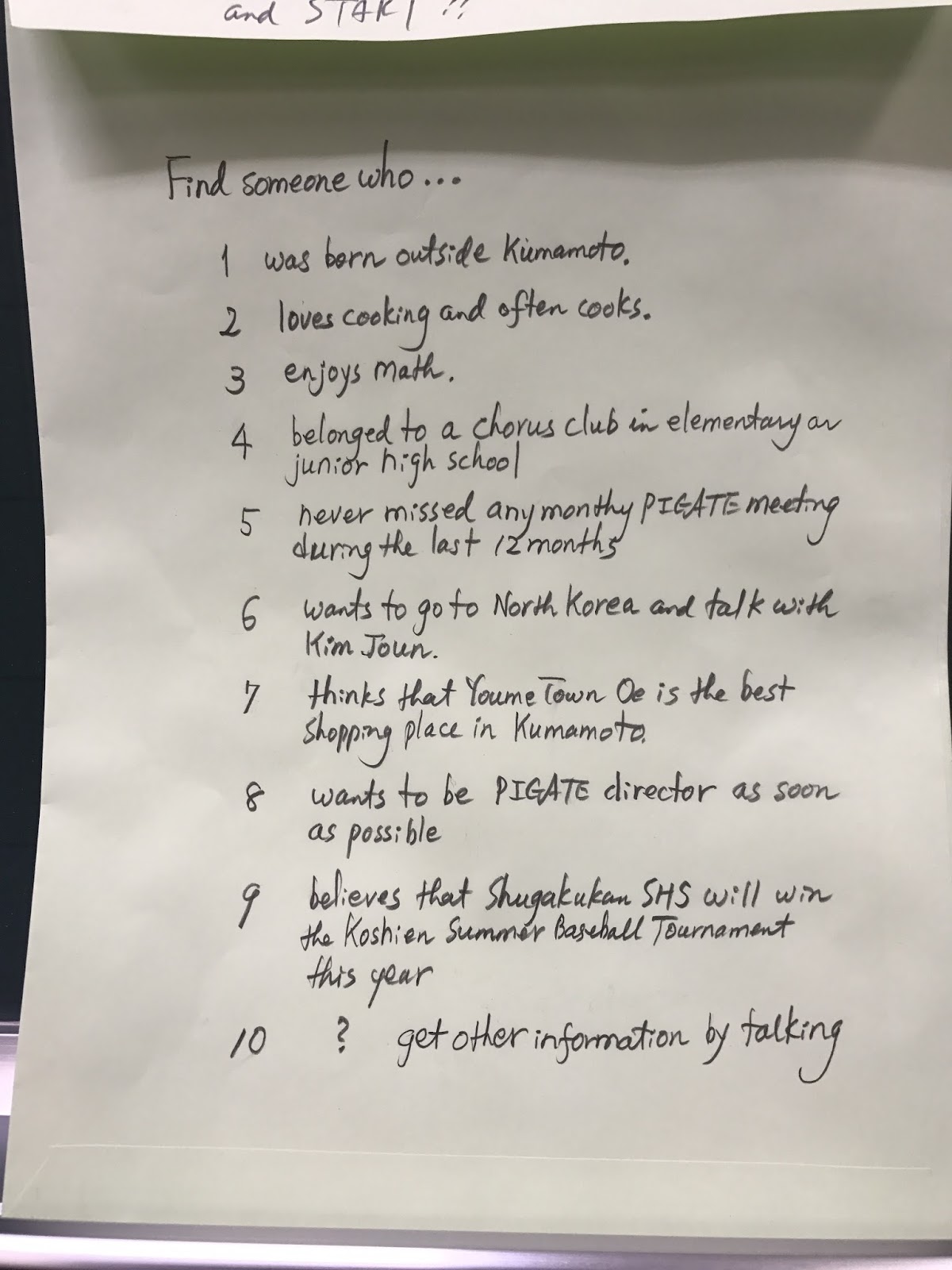
In the morning on Aug. 12, at PIGATE's Special Summer Session (SSS), Mr. Nobuyuki Takaki led a find-someone-who activity, which he introduced with "instruction checking questions" (The PIGATE Blog, 2017.06.01), and 10 interaction prompts that he'd printed on a large envelope (snapshot below).
Find-someone-who interaction prompts for the SSS, 2017.08.12
Afterwards, when participants had shared their findings, and were reflecting on the activity in general, Mr. Takaki made a point of mentioning that it had been an integrated-skills activity, in which participants had listened, read, spoken, and written. When I feigned surprise that participants had used all four basic skills (listening, reading, speaking, and writing) during the activity, Mr. Takaki reiterated the point, so I'm quite certain that participants got it.
Paul Beaufait, The Prefectural University of Kumamoto
Summer homework, to the best of my recollection, wasn't a big thing way back when I was growing up in Missoula, MT, half a century or so ago. As a matter of fact, the concepts of homework (school work) and vacation—"freedom or release" from school (Dictionary.com, vacation, definition 3), still seem diametrically opposed. Air-conditioning wasn't a big thing in many places, either.
Reading, however, was a big thing, at least in my family. Visits to the public library downtown were, generally speaking, a weekly affair. During the summer they may have been even more frequent.
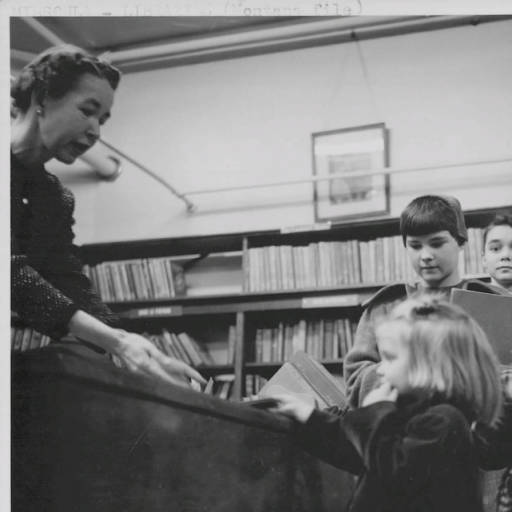
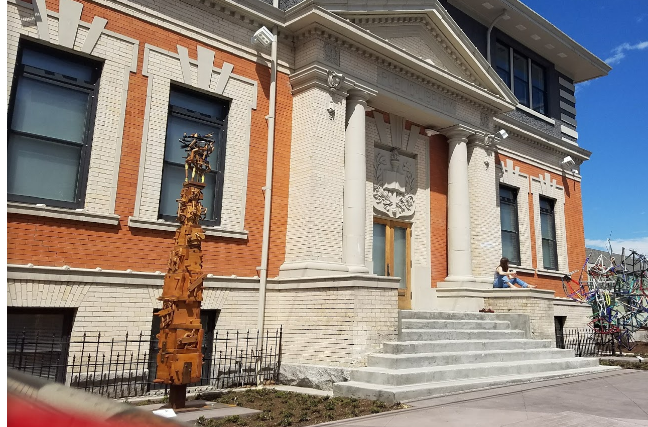
Though the archive photo below predates my childhood reading career by a few years, and the children's coats (and the date stamped on on the back of the photo) suggest a colder season, the Children's room was in the basement of a Carnegie grant-funded library building. That basement remained pleasantly cool throughout the summer!
Children and books at the Missoula Public Library (1956)
As I recall, there were story hours once a week, and children could get library cards as soon as they could sign their names—in cursive not printed script. However, the one book per child checkout limit proved irksome.
Once I'd gotten hooked on reading, one of my parents had to check out extra books to get us through the week. It wasn't too long before they had to persuade the librarian to let me check out books from the upper-elementary school stacks.
This post ... includes ... a slideshow introducing PIGATE's Special Summer Session [SSS] at the Prefectural University of Kumamoto, August 13, 2016. [It also may display recent earmarked Tweets about or related to the SSS.]
You can find the working agenda for this year's SSS in the PIGATE calendar on the Calendar of Events page of The PIGATE Blog. Directions to the SSS venue are on the Meeting Location page.
Tweet about it: #higopigateSSS
[74 words]
PS: Here are a few snapshots from the SSSession.
Thanks to Misato for rounding up delicious boxed lunches from RanTen in Mashiki-machi!
Should Ford have used the word farther instead of further for promotional displays at the Women's World Curling Championships? They definitely needn't have capitalized the F-word in their tagline, and missed out sentence final punctuation as well.
Word-choice arguments, as you might imagine, can go full circle. For starters, an Oxford Dictionaries' grammar and usage resource made no distinctions, when talking about distance; it argued, "[B]oth are equally correct."
But isn't that like arguing two stones are equally close to the center of the house? If you watched the end of semi-final play between Japan and Russia yesterday (relative time), you may recall that the Japanese team quickly conceded a second point for closeness in the house on the 10th end, and won outright with two points of their own in the 11th.
Cambridge Dictionaries Online's argument included similar nuances: "There is no difference in meaning between them," when talking about distance. However, "[t]here are some occasions when we can use further[,] but not farther. / We use further before a noun to mean 'extra', 'additional' or 'a higher level'"
(http://dictionary.cambridge.org/us/grammar/british-grammar/farther-farthest-or-further-furthest).
The Canadian Oxford Dictionary Online called farther a "var[iant] of further …" (2005, inaccessible after first viewing), but wouldn't reveal the definition of further without a purchase or subscription. The definition of one word isn't much of a sample to preview, eh?
Grammar Girl surmised, "The quick and dirty tip is to use 'farther' for physical distance and 'further' for metaphorical, or figurative, distance. It's easy to remember because 'farther' has the word 'far' in it, and 'far' obviously relates to physical distance" (http://www.quickanddirtytips.com/education/grammar/further-versus-farther).
A professor in Adelaide, Australia, Derek Abbott, has begun studying animal sounds as they would appear in comic strip speech balloons, according to posts in The Guardian and on the Mother Nature Network:
Laura Moss, Mother Nature Network (MNN) (2016.02.23)
Both posts point to a website displaying Abbott's rather comprehensive collection of Animal Sounds, some transliterated into English from native language scripts. The MNN post also points to the video below featuring native speakers [of various languages] producing animal sounds.
On June 13th, Mr. Taishi Kaneko (right) made his début as an emcee for guest speakers Mr. Hiroshi Fukushima (left) and Prof. Richard Lavin (center) at the PIGATE gathering in the KGU English Lounge. I hope we'll see and hear from them all again soon!
Mr. Kaneko introduced the guest speakers.
Along with a bit of historical and theoretical background, Mr. Fukushima and Prof. Lavin introduced two types of shadowing. The first focused learners' attention on the sounds of the target language, and the second focused on content–namely vocabulary, syntax (grammar) and meaning.
PIGATE members had opportunities to try a little of both types. Then Mr. Fukushima reported on an on-going study to assess the effectiveness of shadowing relative to standardized test results.
Prof. Takaki summed up the session.
Below are a couple of books on shadowing(Kadota, 2007, and Tamai, 2005) highlighted either in the presentation itself or in Prof. Takaki's summary. The other (Kadota, 2012), which I discovered today at Amazon, JP, appears to be a follow-up on the first.
Kadota, Shuuhei. (2007). シャドーイングと音読の科学 [shadouingu to ondoku no kagaku: the science of shadowing and reading aloud]. Tokyo, JP: Cosmopia.
Kadota, Shuuhei. (2012). シャドーイング・音読と英語習得の科学 [shadouingu, ondoku to eigo shutoku no kagaku: the science of shadowing, reading aloud and English acquisition]. Tokyo, JP: Cosmopia.
Tamai, Ken. (2005). リスニング指導法としてのシャドーイングの効果に関する研究 [risuningu shidouhou toshite no shadouingu no kouka ni kan suru kenkyuu: a study of the effects of shadowing as a method for teaching listening]. Tokyo, JP: Kazama Shobou.
Though there seemed to be a general consensus among audience members about the potential of shadowing for dedicated individual language learners, a question remained about how teachers might adopt and adapt such practices for general classroom instructional purposes.
If you have other key readings to suggest, other questions about shadowing, or suggestions regarding shadowing and classroom teaching practices in particular, please feel free to spell them out in comments on this post.
Can you spot Nobel Prize winner Malala Yousafzai in the line-up below? It's easy if you filter the TIME 100 display by age. She's one of only two under-twenties and the only under-twenty activist.
You can read what Gabrielle Giffords, a survivor of a different assassination attempt, wrote about Malala by clicking on the thumbnail photo of Malala in the TIME 100 display.
Interestingly enough, eight of the total eleven activists are women, and three of those eleven are from Asia. Do you recognise anyone else?
Pictures and information from PIGATE's 1st meeting of 2015 are below!! Despite end of the term tests and other obligations, we welcomed 20 participants to the January meeting of PIGATE, again held at the English Lounge.
Ai Sakaida, a fourth year student in the Foreign Language Department at Kumamoto Gakuen, was the chief for the session and opened the session by introducing Chuck.
First of all, I'd like to congratulate Ms. Fukushima (right) on her role leading the meeting at KGU on December 13th, 2014. For a teacher in training, it took a lot of courage to do so in English, an additional language for her. I have no doubt that as she gains public speaking experience of that sort she will need to rely less and less upon prepared scripts.
Three other main speakers rounded out the schedule.
Hi, I'm Paul Beaufait, one of the greybeards and the
only person wearing a tie in the group photo from the Dec.
2014 meeting at KGU last Saturday. I forgot to take the tie off on my way over from the Prefectural University of Kumamoto (PUK), where I'd been attending senior presentationsthat same morning.






 First of all, I'd like to congratulate Ms. Fukushima (right) on her role leading the meeting at KGU on December 13th, 2014. For a teacher in training, it took a lot of courage to do so in English, an additional language for her. I have no doubt that as she gains public speaking experience of that sort she will need to rely less and less upon prepared scripts.


