This blog is for PIGATE, a grass-roots pre- and in-service teacher development group in Kumamoto, JP. Our monthly meetings are every 2nd Saturday, usually from 1:30-4:30 p.m. For more information, please contact pigateadvisor01 (aT) Gmail (dOt) com.
For adult learners, parents, and teachers keen
on learning about reading disorders, dyslexia in particular, an updated book appears
to be an important addition to the field.
According to the Amazon book blurb, this edition of Overcoming Dyslexia by Shaywitz and Shaywitz (2020) offers "new information on all aspects of dyslexia and reading problems, and ... the tools that parents, teachers, and all dyslexic individuals need" (Read more, para. 1). The audible sample (Listen [1st author reading aloud?]) starts in Part I, Chapter 1, The Power of Knowing (Look inside, pp. 3-5) at Amazon.com.
An Online Tutor Business Coach, Joanne Kaminski, who recently streamed a video review, argued that a crucial take-away from this book about dyslexia is the importance of early diagnoses (2021.08.30).
Shaywitz, S. E., & Shaywitz, J. (2020). Overcoming dyslexia: A major update and revision of the essential program for reading problems at any level, incorporating the latest breakthroughs in science, educational methods, technology, and legal accommodations. Alfred A. Knopf.
A Google Site that I'm using to reconstitute bits and pieces of new and previous online endeavours, the Beaufait Collaboratoire, grew new pages and subpages today.
Most notable was a new Educators' Corner, now a ProDev subpage. Other additions included a couple of Google Forms for surveys of EnglishCentral (EC) users that I have embedded in EC subpages. I'd linked to the forms previously from the Tech. Tools page to replace old wiki resources.
Please feel free to browse the Collaboratoire, and let me know in comments on this post if you have any questions or discover any incipient web rot (faulty links).
As I continue to build and update that site, I'm seeking a communication interface to include there. Something like the threaded comment functionality of Blogger blogs might be ideal. In the meantime, I welcome your suggestions in comments here.
[146 words]
Monday, June 17, 2019
Linguistic paranoia – why is Australia so afraid of languages?
For most other countries speaking more than one language is the norm.
Image from www.shutterstock.com.au
About 20% of the Australian population speaks a language other than English. In fact, around 250 languages are spoken in homes around the country. This would seem to be cause for celebration. After all, successive governments have spent millions trying to increase the numbers of students studying languages in schools. However there is little connection between the languages taught in schools, and the languages spoken in homes.
Foreign language learning in schools
In 2001 the Howard Liberal government set a target of 25% of Year 12 students studying a foreign language. The same target was set by the incoming Rudd Labor government in 2007. In 2014, the new Abbott Liberal government upped the ante to 40% of Year 12 students studying a foreign or classical language within the decade. This was ambitious given that the previous targets of 25% had never been reached.
Barely 10% of Year 12 students study a language. Yet 20% of the population speaks a language other than English in the home. How does that add up? The answer is governments pay little heed to the languages spoken in Australian homes; they prefer “foreign and classical” languages to “local and community” ones.
Not all languages are equal
There is a clear hierarchy of languages in Australia. English is at the top. Next are the “classical” languages like French and German, particularly when learned at school. These are followed by languages deemed useful for Australia’s economic prosperity - e.g. Chinese, Indonesian and Japanese - but only if they are being learned as “foreign” languages. Because that is quite clever, learning a foreign language.
But if they are languages already spoken in the home, they slip down the hierarchy of languages, into the community languages pile along with about 245 other languages. Somewhere towards the bottom of that community languages pile are the Indigenous languages of Australia, about which most Australians know nothing.
The chances of those 245 community languages surviving in Australia are remote. Australia is remarkably adept at wiping out languages. Of the 250 Indigenous languages in existence at the time of British colonisation, only around 20 remain viable today. The languages immigrants bring with them are usually dead within two generations.
It seems remarkably odd policy to pour millions of dollars into setting consistently unachievable targets for learning foreign languages at school, while simultaneously watching community languages slide into oblivion.
Is it just linguistic snobbery?
We always seem more impressed by a native English speaker who has managed to learn another language at school than we are by those who learn their languages at home.
Everyone was quite impressed by ex Prime Minister Rudd’s proficiency in Mandarin, but I expect Senator Dio Wang’s Mandarin runs rings around Mr Rudd’s. I’m guessing Belgian born Finance Minister Mathias Cormann speaks German, Flemish, and perhaps also French. I suppose Senator Nick Xenophon speaks Greek, but perhaps he doesn’t. Maybe his Greek language heritage has been lost, which would be ironic as his surname means “foreign voice”. Does Deputy Opposition leader Tanya Plibersek speak Slovenian? Does the Malaysian born Leader of the Opposition in the Senate, Penny Wong speak Malay and Mandarin or Cantonese or Hakka?
I don’t know. I’ve never heard any of them speak another language, or be reported admirably in the press for their linguistic prowess. They don’t note their bilingualism in their biographies on their websites. Perhaps they’ve lost their heritage languages - or perhaps it’s just not “Australian” to say you speak another language in your home or to your mum and dad. Either scenario is a sad indictment.
It seems, in Australia, if you learned your second language at school or at university - that’s clever and admirable. If your bilingualism comes from your heritage, we’d prefer to ignore it.
Multicultural but monolingual
Australia is generally happy to be multicultural, as long as that just involves some tasty food, and a bit of dance and music at an annual festival. We are definitely not comfortable with being multilingual. We are a country where you are free to speak another language, but preferably in the privacy of your own home or on an overseas holiday. It seems we like our foreign languages to stay that way - foreign.
Australia is currently in a social and political space where “unity” has overtaken “diversity” as the preferred political discourse. A country that speaks multiple languages in its everyday life seems somehow harder to manage. After all, who knows what they’re saying? A community that speaks foreign languages to foreign people in foreign lands is much more secure.
It is odd we should be so determined to keep our multilingualism in the closet. For most other countries speaking more than one language is the norm. With so many economic, cognitive, social and political advantages to multilingualism it seems simultaneously extraordinarily wasteful and absurdly paranoid to not celebrate and nurture the languages spoken in homes all around the country.
Screenshot of PDF at ceu.edwebpd.net (https://goo.gl/K19W66)
EdWeb is a free professional learning network. Its Browse and Search edWebinars pages listed 1564 webinars today (2019.03.06 [JST]) in, just a guess, hundreds of communities.
Screenshot of Select Community menu
Please check it out, and leave comments on this post to let us know what you think.
Creating and implementing interactive tasks based on self-determination theory—for young learners and the young at heart!
By David Ockert, Toyo University
David Ockert’s teaching interests are in critical thinking, reading comprehension, and academic writing. He does research on the influence of technology on affective variables (motivation, confidence, anxiety, and willingness to communicate). David also enjoys creative lesson planning for communicative purposes, using a task-based language teaching (TBLT) approach via the three pillars of self-determination theory [SDT]: competence (mastery), relatedness, and autonomy.
For this presentation, David will focus on self-determination theory-based EFL motives interconnected with competence, relatedness, and autonomy. He will show how all three can be incorporated easily into any level of pedagogy, with a focus on the junior high school level in Japan. [UPDATE, 2018.09.10: This presentation will be a participatory event with very little lecture. David will lead participants through hands-on tasks, with evaluation of each afterwards, to provide a real-world experience of how and why SDT-based lessons work.]
Date & time
Saturday, September 15, 2018; 13:30–16:30
Venue
Seminar room 10, Faculty of Administrative Studies office wing, Prefectural University of Kumamoto (PUK): Please see PIGATE Meeting Locations (https://goo.gl/h5DgbP) for details.
Attendance plans
Hoping or planning to attend? Please let us know by filling out an attendance form:
If you'd also like to attend an informal networking event afterwards (tentatively 18:30–20:30), please ... add, "Post-function: Yes!" (without quotation marks) along with your email address as Additional info. at the end of the form [2018.09.13: ... ask Paul in person on Saturday whether a seat is still available].
Kaichi School, Matsumoto, JP, photographed May 31, 2013,
by Paul Beaufait. All rights reserved.
How much time do students spend in school?
"There is no consistent pattern ... among top-performing education systems. / This suggests that when it comes to student performance, more important than the amount of time students spend in class is how that time is spent" (Craw, 2018 [emphasis in original]).
This post displays Google slides [and references] from part two of the PIGATE gathering on March 10, 2018. The presenter's blurb for the program that day read:
In this workshop, participants will make, share, and refine self-assessments, then project and reflect on goals and resources for additional personal and professional language development.
(PIGATE meeting agendas, 2018.03.10)
To find out about what ensued, please ask one or more of the language teachers who took part, ...
... or post questions in comments on this post, where all of the participants can respond.
Wondering, you may be, ... ... what happened to the PIGATE Blog. Well, it got a facelift today—a new theme chosen for simplicity and readability, and vetted with contributors. We hope you like the new look, and welcome feedback in comments or reactions on this post.
The screenshot below shows three websites I've earmarked recently for PIGATE by tagging them and sharing them in Diigo, a social bookmarking service. The list on the ... [right] side shows the top ten tags in use since May 2015.
For example, a few days before Mr. Kobori's presentation on September 9th, 2017, I discovered a homepage offering a free, open source typeface designed to help "make reading easier for [people with] some symptoms of dyslexia" (https://opendyslexic.org/faq/, ¶1).
Though the PIGATE Diigo Group currently is private, anyone can find and use bookmarked website links in an RSS feed on the PIGATE Blog sidebar (Diigo Bookmarks: Group PIGATE's best content).
PIGATE members are more than welcome to join. I'd love to see what websites other little piggies recommend for each other.
A special exhibition on the Lascaux Cave will be at the Kyushu National Museum in Daizaifu (Fukuoka, JP) until Sunday, September 3, 2017. If you have time to spare, this is an exhibit not to miss!
Lascaux: Cave Paintings of the Ice Age
(2017.08.22 ticket stub)
For an in-depth, audio-visual and text presentation of the cave, its history, and its preservation, please visit the French Ministère de la Culture website:
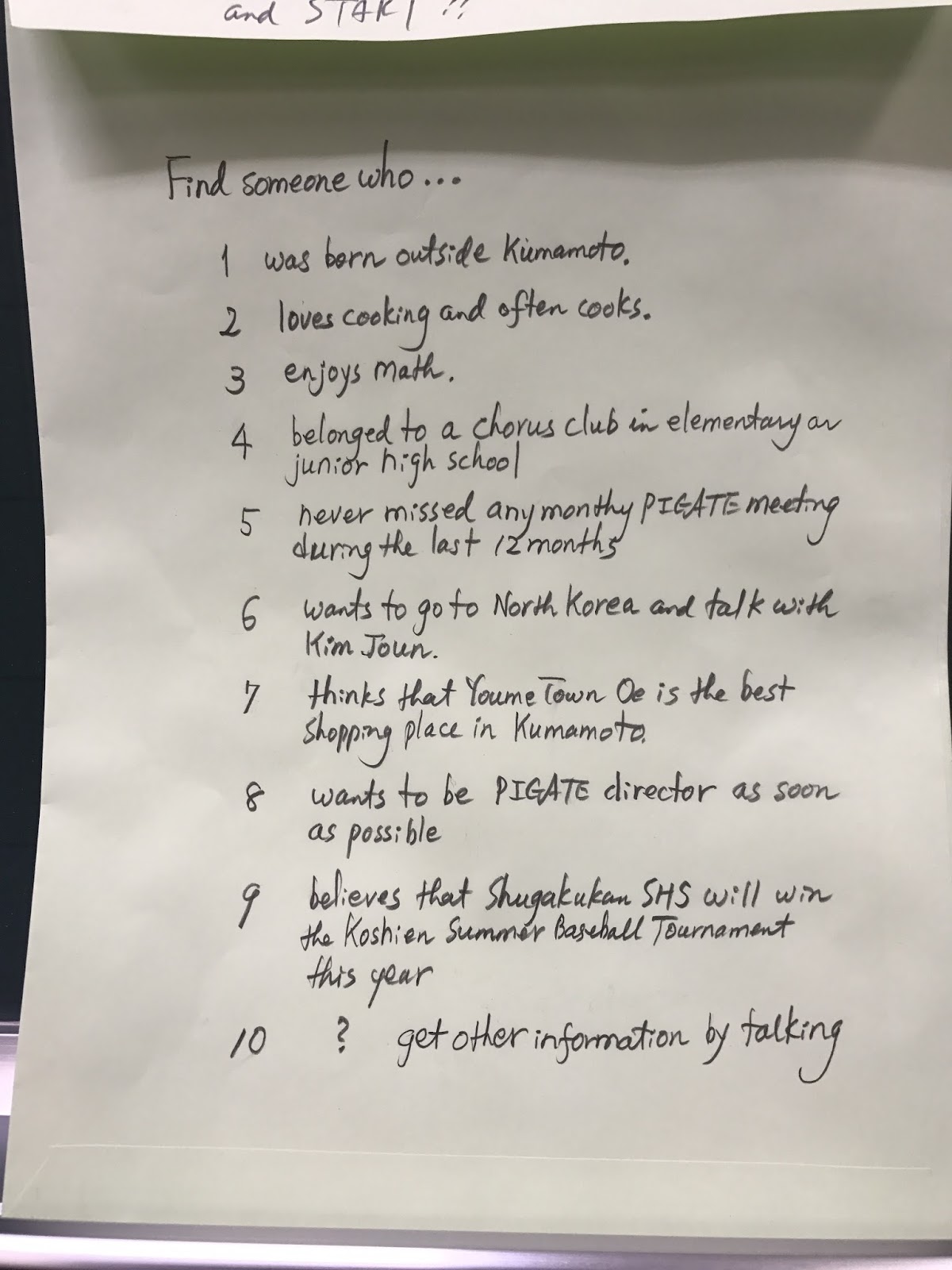
In the morning on Aug. 12, at PIGATE's Special Summer Session (SSS), Mr. Nobuyuki Takaki led a find-someone-who activity, which he introduced with "instruction checking questions" (The PIGATE Blog, 2017.06.01), and 10 interaction prompts that he'd printed on a large envelope (snapshot below).
Find-someone-who interaction prompts for the SSS, 2017.08.12
Afterwards, when participants had shared their findings, and were reflecting on the activity in general, Mr. Takaki made a point of mentioning that it had been an integrated-skills activity, in which participants had listened, read, spoken, and written. When I feigned surprise that participants had used all four basic skills (listening, reading, speaking, and writing) during the activity, Mr. Takaki reiterated the point, so I'm quite certain that participants got it.
Paul Beaufait, The Prefectural University of Kumamoto
"The most powerful learning
experiences often happen when children are simply given the space to work things out on their
own — to come up with their unique way to occupy [their time]" (Gallup, 2017, p. 1).
Summer homework, to the best of my recollection, wasn't a big thing way back when I was growing up in Missoula, MT, half a century or so ago. As a matter of fact, the concepts of homework (school work) and vacation—"freedom or release" from school (Dictionary.com, vacation, definition 3), still seem diametrically opposed. Air-conditioning wasn't a big thing in many places, either.
Reading, however, was a big thing, at least in my family. Visits to the public library downtown were, generally speaking, a weekly affair. During the summer they may have been even more frequent.
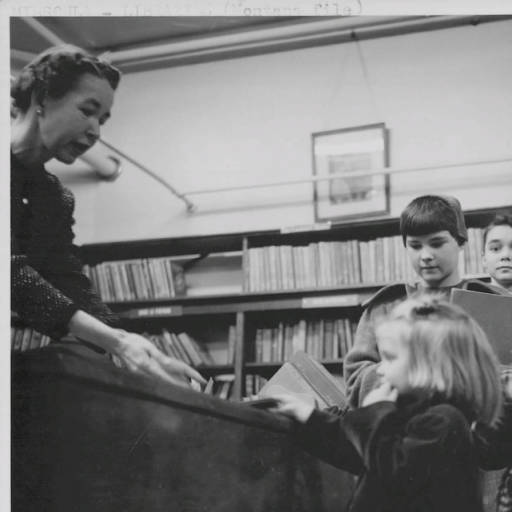
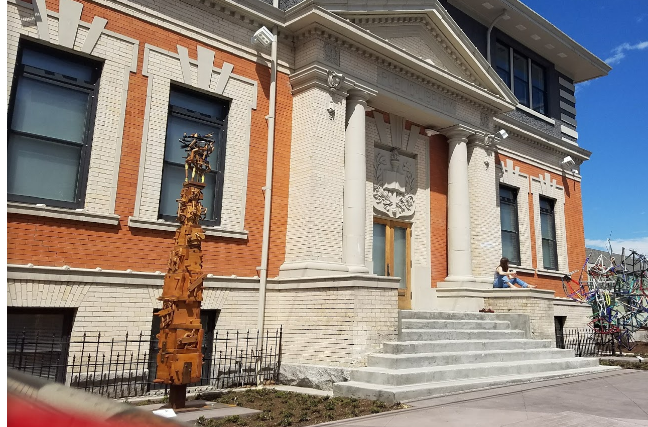
Though the archive photo below predates my childhood reading career by a few years, and the children's coats (and the date stamped on on the back of the photo) suggest a colder season, the Children's room was in the basement of a Carnegie grant-funded library building. That basement remained pleasantly cool throughout the summer!
Children and books at the Missoula Public Library (1956)
As I recall, there were story hours once a week, and children could get library cards as soon as they could sign their names—in cursive not printed script. However, the one book per child checkout limit proved irksome.
Once I'd gotten hooked on reading, one of my parents had to check out extra books to get us through the week. It wasn't too long before they had to persuade the librarian to let me check out books from the upper-elementary school stacks.
The presentation that I've embedded in this post uses time-lapse screenshots to replicate several stages of mind map development. The mind map of a favorite place is a work in progress[.]
I created the mind map with FreeMind—free, open source software from SourceForge; and have continued to develop it with FreePlane—also available for free from SourceForge. The background photo in the penultimate slide, I took from my veranda on March 14, 2017.
If you have concerns or questions about mind-mapping tools; or suggestions of novel, possible, and practical uses for learning or teaching [with them]; please don't hesitate to spell them out in comments on this post.
First of all, I'd like to thank the directorate and membership of PIGATE for the opportunity that Mr. Hirotaka Terada and I had to make an extended presentation about social media for PIGATE, at Kumamoto Gakuen University (KGU) on June 11th, 2016. It was encouraging to see how determined the director, Mr. Nobuyuki Takaki, and other members of the group were to resume PIGATE-style grassroots teacher development activities, in spite of severe consequences of earthquakes in Kumamoto. I'd like to extend special thanks to Prof. Joseph Tomei for making arrangements for the PIGATE group to meet at KGU in both June and July.
In the aftermath of the tremors, which necessitated cancellation of the PIGATE gathering in May, it was a challenge to plan and develop contributions for a joint presentation entirely at a distance. Though Terada and I had exchanged a few ideas face-to-face after the meeting in April, we depended completely upon internet communication technology (ICT) from then until we met again at KGU a few minutes before the June meeting began. So this had become an opportunity to both explore and employ handy and useful online media in collaborative presentation development.
Beyond 1) basic email service (Gmail) underpinning our initial contacts and endeavours, 2) a social networking service that both presenters use regularly (LINE), and 3) a shared Google presentation around and on which to collaborate; possible social media upon which to focus our presentation were virtually uncountable (see: The Conversation Prism 4, 2014, below).
Our shared Google presentation, now public on the PIGATE Blog (2016.06.12), included pretest and posttest items to assess audience members' knowledge and beliefs with regard to the nature of social media and uses of them. Pretest responses, the presenters hoped, would lay a foundation for a working definition of social media. Initial discussion of personal and professional purposes rounded out common characteristics of social media that Obar & Wildman (2015) had identified, namely:
Internet-based applications (apps),
User-generated content,
User- and group-specific profiles for apps or websites, and
Networking services facilitating connections amongst users and groups.
As had a couple of PIGATE members who'd responded to the Monthly Special prompt for the Dec. 2015 newsletter (No. 267, 2016.01.01, pp. 27-28, https://goo.gl/mQ6Dio), Terada expressed a preference for online communication via LINE (Free calls and messages). So the presenters used LINE for Voice-over Internet Protocol (VoiP, https://goo.gl/D4YMBG) calls to talk through research and development of their presentation, as well as for text messages to arrange and follow-up on those VoIP calls.
Terada's findings reflected extended discussions with twenty classmates and friends, who'd used mainly LINE, Facebook, and Twitter, and to a lesser extent Instagram. Those discussions explored various merits and demerits of social networking service (SNS) use, as well as trouble that users or their friends had encountered. In a nutshell, Terada found such SNSs useful for one-way distribution of information, yet problematic when responses were desirable or necessary.
Beaufait pointed out benefits of social media use that the Online Learning Consortium (2016) had reported for online instructional programs, in particular potential for:
Learner engagement (and retention),
Instructional effectiveness–achieving desired learning outcomes, and
Provisions of career and educational support services.
Beaufait also called attention to passive (automatically collected) and active (individually produced) data found in so-called digital footprints, or virtual representations of our real-life selves (Oglethorpe, 2012). Such footprints may work either against or for job-seekers, professional program applicants, or students in general. Beaufait noted that, in the eyes of some schools, "A Google search result is your portfolio" (Leigh Blackall, Teaching and learning online [TALO] Google group mailing list, 2016.06.01, emphasis added).
Discussion periods throughout the presentation explored numerous questions–many more than possible to answer in-session to everyone's satisfaction, for example:
What's social about social media–if people use them merely as tools for broadcasting personal information, rather than for facilitating and promoting educational exchanges or socially responsible endeavours;
What changes may be taking place in attitudes and practices with respect to privacy and control of personal information in highly-interconnected online communities, groups, and networks; and
What can we as educators and language learners do to maximize benefits and minimize risks of social media use, for both personal and professional purposes, as well as for students–young ones in particular, whom we may serve as trail-breakers, role-models, guides, or coaches?
Among the references for our presentation in the slideshow on the PIGATE Blog, I'd like to highlight Davis (2015) as the source for Web-guides for teachers (currently slide 54), and to double up on Couros (2011, 2013, 2016a, & 2016b). George Couros (@George Couros, https://goo.gl/0c4J1T) not only granted permission for use of a custom graphic in animation of Bringing community into classrooms (currently slide 58), but also has provided numerous examples and suggestions of ways to use Twitter for professional development purposes.
In wrapping up here, I'd like to encourage everyone, social media users and non-users alike, to review public pre- and post-session tweets here (https://goo.gl/s3K1lu). I also hope you'll take active parts in on-going and future conversations and explorations of potential uses for social media in additional language and professional network development–for both learning and teaching purposes.
Please allow me to close with thanks to all who took part in the June gathering, and a reminder from our presentation (Social media sufficiency, currently slide 62):
"[C]ollaborative conversations alone are often not enough to promote teacher learning and change. Teachers must try complex innovations, and reflect upon these implementations in order to extract from experience the knowledge that leads to improved teaching."
Those of you who've had an opportunity to peruse the slides in Social media for you and me (Beaufait & Terada, 2016.06.11) will have seen dozens of QR codes pointing out various online resources.
Nik's an English language teaching and technology guru that I met several years ago through a series of virtual workshops entitled Blogging for Beginners and Blogging for Educators. EdTechTalk is a Diigo group with which he shared that post 7 June 2016.
If you have any questions about QR codes or suggestions of other ways to use them around your schools, please do not hesitate to spell them out in comments on this post.