Pages

Showing posts with label CPS. Show all posts

Monday, August 5, 2019

Sneak preview of PIGATE's Special Summer Session


PIGATE's Special Summer Session (SSS)


Tentative schedule (as of 2019.07.05)

09:30 Preparation and sign-in (30 min.)
10:00 Opening remarks (10 min.): Paul Beaufait
10:10 IPS, Part 1 (45 min.): English pronunciation challenges for English teachers
10:55 Break (10 min.)
11:05 IPS, Part 2 (45 min): Tactics for teaching oral expression
11:50 Lunchtime (60 min.)
12:50 CPS, Part 1 (45 min.): Favorite picture books and stories to share
13:35 _Kitemiran_¹ and _shitemiran_² sharing time (15 min.)
13:50 CPS, Part 2 (45 min.): Experience and tips for learning and teaching with stories
14:35 Break (15 min.)
14:50 Working Papers (_kiyou_) workshop (45 min.):
Reflections, projections, & progress reports;
Preparation and collaboration time; &
Submission guidelines & deadlines.
15:35 Session summary: Mr. Nobuyuki Takaki (15 min.)
15:50 Closing remarks (10 min.)
Membership matters
Newsletter contributions
Other announcements:
Annual General Meeting (AGM), 2019.09.14
Other
16:00 Clean-up (10 min.)
16:10  Steering committee meeting (20 min.)
Presenters and PIGATE members are welcome to attend the committee meeting!
____________________
¹ Why don't you come and see this?
² Why don't you try this and see?


If you would like to take part in this month's session, or to join PIGATE, please fill out one of our short online info. collection forms (https://goo.gl/Hpe9pd). 

Monday, September 3, 2018

Coming soon: Self-determination theory—for young learners and the young at heart!


Creating and implementing interactive tasks based on self-determination theory—for young learners and the young at heart!

By David Ockert, Toyo University


David Ockert’s teaching interests are in critical thinking, reading comprehension, and academic writing. He does research on the influence of technology on affective variables (motivation, confidence, anxiety, and willingness to communicate). 

David also enjoys creative lesson planning for communicative purposes, using a task-based language teaching (TBLT) approach via the three pillars of self-determination theory [SDT]: competence (mastery), relatedness, and autonomy. 


For this presentation, David will focus on self-determination theory-based EFL motives interconnected with competence, relatedness, and autonomy. He will show how all three can be incorporated easily into any level of pedagogy, with a focus on the junior high school level in Japan.

[UPDATE, 2018.09.10: This presentation will be a participatory event with very little lecture. David will lead participants through hands-on tasks, with evaluation of each afterwards, to provide a real-world experience of how and why SDT-based lessons work.]


Date & time

Saturday, September 15, 2018; 13:30–16:30

Venue

Seminar room 10, Faculty of Administrative Studies office wing, Prefectural University of Kumamoto (PUK): Please see PIGATE Meeting Locations (https://goo.gl/h5DgbP) for details.

Attendance plans

Hoping or planning to attend? Please let us know by filling out an attendance form: 
If you'd also like to attend an informal networking event afterwards (tentatively 18:30–20:30), please ... add, "Post-function: Yes!" (without quotation marks) along with your email address as Additional info. at the end of the form [2018.09.13: ... ask Paul in person on Saturday whether a seat is still available].
[227 {+ 50} words]

Wednesday, November 1, 2017

Teachers' resource book in the KGU library

One of the last times we met in the KGU library, the title on the spine of a book (Shin & Crandall, 2014) caught my eye. So I pulled it out to take a peek. It's in the syllabus corner on the first floor: 

KGU OPAC catalog listing (English)
KGU OPAC catalog listing (Japanese)
Here's a preview of the table of contents:

  • Preface
  • About the Authors
  • Chapter 1: Teaching English to Young learners around the World: An Introduction
  • Chapter 2: Basic Principles of Teaching English to Young Learners (TEYL)
  • Chapter 3: Contextualizing Instruction: Creating Thematic Units and Lesson Plans
  • Chapter 4: Teaching Listening and Speaking
  • Chapter 5: Teaching Reading and Writing
  • Chapter 6: Storytelling
  • Chapter 7: Assessment
  • Chapter 8: Classroom Management
  • Chapter 9: Twenty-First-Century Skills in Teaching English to Young Learners (TEYL)
  • Chapter 10: Professional Development
  • Worksheets
  • Index
(Source: National Geographic Learning, English Language Teaching, 
Product Information, More, Table of Contents, 
retrieved 2017.11.01)

Would you like to have a go at reviewing it for a future newsletter? If so, please send us a heads-up either in a comment on this post or in a message to our Google Group.


Reference

Shin, J. K, & Crandall, J. (2014). Teaching Young Learners English: From Theory to Practice. Boston, MA: National Geographic Learning.

[211 words]

Saturday, August 19, 2017

Short report: A find-someone-who activity

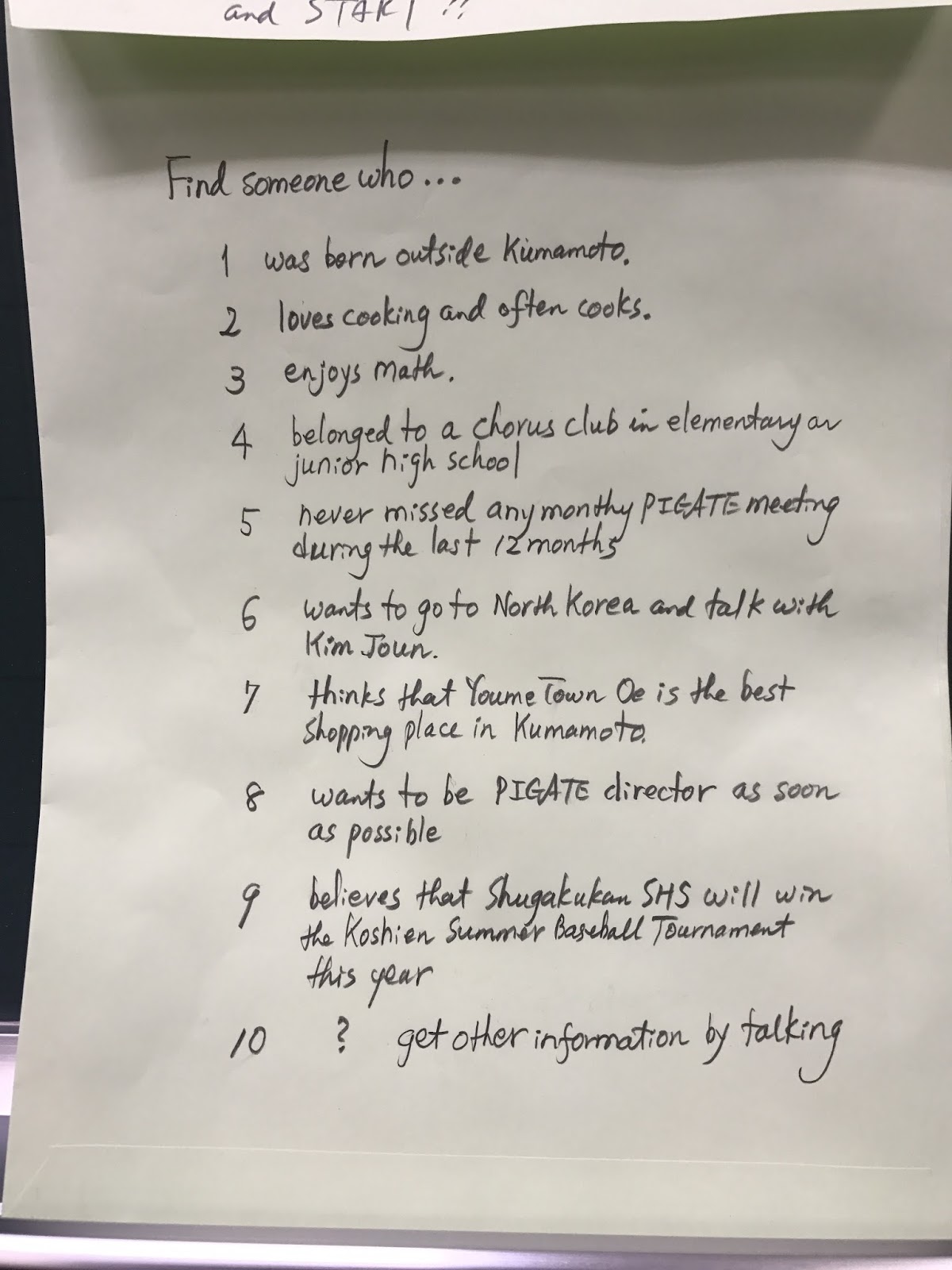
In the morning on Aug. 12, at PIGATE's Special Summer Session (SSS), Mr. Nobuyuki Takaki led a find-someone-who activity, which he introduced with "instruction checking questions" (The PIGATE Blog, 2017.06.01), and 10 interaction prompts that he'd printed on a large envelope (snapshot below).

2017-08-12 12.38.44.jpg
Find-someone-who interaction prompts for the SSS, 2017.08.12

Afterwards, when participants had shared their findings, and were reflecting on the activity in general, Mr. Takaki made a point of mentioning that it had been an integrated-skills activity, in which participants had listened, read, spoken, and written. When I feigned surprise that participants had used all four basic skills (listening, reading, speaking, and writing) during the activity, Mr. Takaki reiterated the point, so I'm quite certain that participants got it.

Paul Beaufait, The Prefectural University of Kumamoto
ボーフェ ポール, 公立大学法人熊本県立大学

Thursday, June 1, 2017

Classroom practice: Using instruction checking questions (ICQs)


This post showcases a presentation that Taishi Kaneko (KU, Fac. of Educ., M2) used for a demonstration and discussion of instruction checking questions (ICQs) at the PIGATE gathering earlier this month (2017.05.13). Taishi began to develop his interest in ICQs while studying overseas last year.


If you have comments or questions regarding ICQs and their use or potential, please feel free to spell them out in comments on this post. Suggestions of and pointers to related resources also are welcome.

[80 words]

Wednesday, August 10, 2016

PIGATE's Special Summer Session: August 13, 2016

This post ... includes ... a slideshow introducing PIGATE's Special Summer Session [SSS] at the Prefectural University of Kumamoto, August 13, 2016. [It also may display recent earmarked Tweets about or related to the SSS.]


You can find the working agenda for this year's SSS in the PIGATE calendar on the Calendar of Events page of The PIGATE Blog. Directions to the SSS venue are on the Meeting Location page.

Tweet about it: #higopigateSSS


[74 words]

PS: Here are a few snapshots from the SSSession.


Thanks to Misato for rounding up delicious boxed lunches from RanTen in Mashiki-machi!


[+ 23 words]

Tuesday, January 6, 2015

Reflections on the monthly meeting: Dec. 13, 2014

First of all, I'd like to congratulate Ms. Fukushima (right) on her role leading the meeting at KGU on December 13th, 2014. For a teacher in training, it took a lot of courage to do so in English, an additional language for her. I have no doubt that as she gains public speaking experience of that sort she will need to rely less and less upon prepared scripts.

Three other main speakers rounded out the schedule.