Pages

Showing posts with label punctuation. Show all posts

Friday, July 12, 2019

The Beaufait Collaboratoire: A Google Site

A Google Site that I'm using to reconstitute bits and pieces of new and previous online endeavours, the Beaufait Collaboratoire, grew new pages and subpages today.
Snapshot of The Beaufait Collaboratoire Home page
Home page snapshot, 2019.07.12

Most notable was a new Educators' Corner, now a ProDev subpage. Other additions included a couple of Google Forms for surveys of EnglishCentral (EC) users that I have embedded in EC subpages. I'd linked to the forms previously from the Tech. Tools page to replace old wiki resources.

Please feel free to browse the Collaboratoire, and let me know in comments on this post if you have any questions or discover any incipient web rot (faulty links).

As I continue to build and update that site, I'm seeking a communication interface to include there. Something like the threaded comment functionality of Blogger blogs might be ideal. In the meantime, I welcome your suggestions in comments here.

[146 words]

Monday, September 3, 2018

Coming soon: Self-determination theory—for young learners and the young at heart!


Creating and implementing interactive tasks based on self-determination theory—for young learners and the young at heart!

By David Ockert, Toyo University


David Ockert’s teaching interests are in critical thinking, reading comprehension, and academic writing. He does research on the influence of technology on affective variables (motivation, confidence, anxiety, and willingness to communicate). 

David also enjoys creative lesson planning for communicative purposes, using a task-based language teaching (TBLT) approach via the three pillars of self-determination theory [SDT]: competence (mastery), relatedness, and autonomy. 


For this presentation, David will focus on self-determination theory-based EFL motives interconnected with competence, relatedness, and autonomy. He will show how all three can be incorporated easily into any level of pedagogy, with a focus on the junior high school level in Japan.

[UPDATE, 2018.09.10: This presentation will be a participatory event with very little lecture. David will lead participants through hands-on tasks, with evaluation of each afterwards, to provide a real-world experience of how and why SDT-based lessons work.]


Date & time

Saturday, September 15, 2018; 13:30–16:30

Venue

Seminar room 10, Faculty of Administrative Studies office wing, Prefectural University of Kumamoto (PUK): Please see PIGATE Meeting Locations (https://goo.gl/h5DgbP) for details.

Attendance plans

Hoping or planning to attend? Please let us know by filling out an attendance form: 
If you'd also like to attend an informal networking event afterwards (tentatively 18:30–20:30), please ... add, "Post-function: Yes!" (without quotation marks) along with your email address as Additional info. at the end of the form [2018.09.13: ... ask Paul in person on Saturday whether a seat is still available].
[227 {+ 50} words]

Wednesday, January 17, 2018

New presentation resources on the LTD Project Wiki

Here are two of three of today's additions to LTD Project Wiki, SpeakingPresenting page:

Prezi. (2017.07.05). Harvard researchers: Prezi is more engaging, persuasive, and effective than PowerPoint [weblog post]. Retrieved January 17, 2018, from https://blog.prezi.com/university-study/
  • This weblog post summarised Harvard researchers ... findings (Moulton, Türkay, & Kosslyn, 2017; above).

Prezi. (2018 [n.d.]). The science of effective presentations [webpage]. Retrieved January 17, 2018, from https://prezi.com/the-science/

  • This infographic-style web page represented Prezi-related findings summarised in Harvard researchers ... (Prezi, 2017.07.05; above).

The third addition was the research paper by Moulton, Türkay, & Kosslyn (2017).

[100{-1} words]

Wednesday, November 1, 2017

Teachers' resource book in the KGU library

One of the last times we met in the KGU library, the title on the spine of a book (Shin & Crandall, 2014) caught my eye. So I pulled it out to take a peek. It's in the syllabus corner on the first floor: 

KGU OPAC catalog listing (English)
KGU OPAC catalog listing (Japanese)
Here's a preview of the table of contents:

  • Preface
  • About the Authors
  • Chapter 1: Teaching English to Young learners around the World: An Introduction
  • Chapter 2: Basic Principles of Teaching English to Young Learners (TEYL)
  • Chapter 3: Contextualizing Instruction: Creating Thematic Units and Lesson Plans
  • Chapter 4: Teaching Listening and Speaking
  • Chapter 5: Teaching Reading and Writing
  • Chapter 6: Storytelling
  • Chapter 7: Assessment
  • Chapter 8: Classroom Management
  • Chapter 9: Twenty-First-Century Skills in Teaching English to Young Learners (TEYL)
  • Chapter 10: Professional Development
  • Worksheets
  • Index
(Source: National Geographic Learning, English Language Teaching, 
Product Information, More, Table of Contents, 
retrieved 2017.11.01)

Would you like to have a go at reviewing it for a future newsletter? If so, please send us a heads-up either in a comment on this post or in a message to our Google Group.


Reference

Shin, J. K, & Crandall, J. (2014). Teaching Young Learners English: From Theory to Practice. Boston, MA: National Geographic Learning.

[211 words]

Wednesday, September 13, 2017

Sesame Street: Alphabet Songs Compilation | Learn the ABCs!

At our gathering last Saturday, questions arose regarding how and when to help young English learners recognize, recall, and write letters of the alphabet.

For example, with regard to a presentation on dyslexia, participants wondered where the small letter D came from, and why it was so different from the big D.

Though I'll leave reporting details of the session to others who attended or presented, I would like to share a clue to the origin of the letter D:

Image source: Wikimedia Commons

I'd also like to point out a new video from Sesame Street (2017.09.08) offering musical alternatives to traditional ABC songs. Like most songs of this ilk, it focuses on capital letters.

What impressed me the most was the searchable transcript (lyrics) that you can display from the menu under the "..." button below the lower right corner of the YouTube video on site.

Select, "Open transcript," in the pop-up menu, then choose, "English - CC (English)," at the foot of the transcript window, for closed captions (rather than the auto-generated transcript).

Video source: Sesame Street's Back to School playlist

Below are a couple of snapshots of the transcript display with the timecode toggled either ON (at 00.01) or OFF (at 03:29 of 12:50). If you click on the images below, you can see details.

Alphabet Songs Compilation [+ transcript {00.01/12.50}]

Alphabet Songs Compilation [+ transcript {03.29/12.50}]
[255 words]

Monday, July 17, 2017

Monthly special topic: Summer vacation homework

夏休みの宿題

Summer homework, to the best of my recollection, wasn't a big thing way back when I was growing up in Missoula, MT, half a century or so ago. As a matter of fact, the concepts of homework (school work) and vacation—"freedom or release" from school (Dictionary.com, vacation, definition 3), still seem diametrically opposed. Air-conditioning wasn't a big thing in many places, either.

Reading, however, was a big thing, at least in my family. Visits to the public library downtown were, generally speaking, a weekly affair. During the summer they may have been even more frequent.

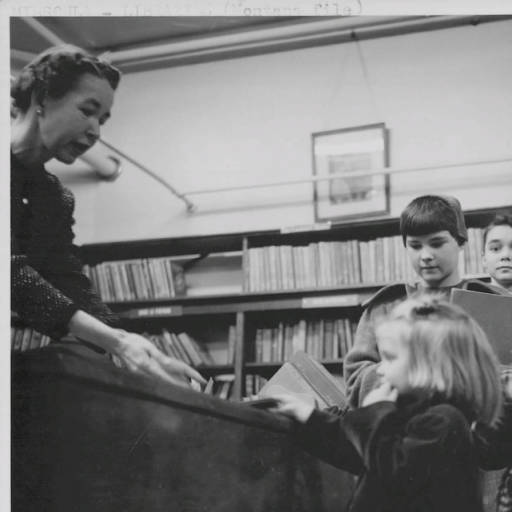
Though the archive photo below predates my childhood reading career by a few years, and the children's coats (and the date stamped on on the back of the photo) suggest a colder season, the Children's room was in the basement of a Carnegie grant-funded library building. That basement remained pleasantly cool throughout the summer!

Children and books at the Missoula Public Library (1956)
Image source: Montana Memory Project (https://goo.gl/QHH82m)

As I recall, there were story hours once a week, and children could get library cards as soon as they could sign their namesin cursive not printed script. However, the one book per child checkout limit proved irksome.

Once I'd gotten hooked on reading, one of my parents had to check out extra books to get us through the week. It wasn't too long before they had to persuade the librarian to let me check out books from the upper-elementary school stacks.

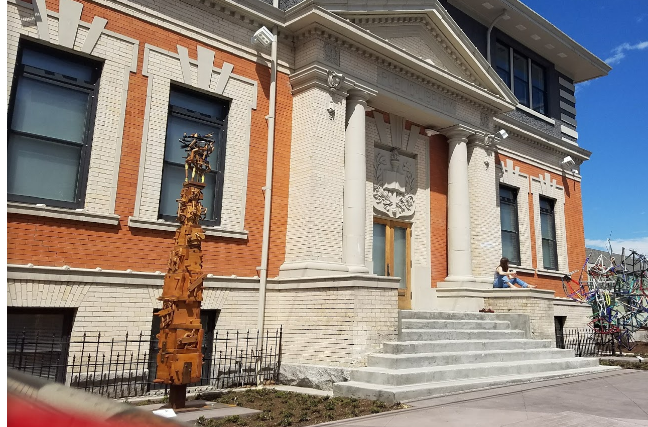
The old library building now is home to the Missoula Art Museum (http://www.missoulaartmuseum.org/), which offers a wide-range of art experiences for children (https://goo.gl/oQonjP).

Missoula Art Museum (Google).PNG
Missoula Art Museum, 335 N. Pattee St., Missoula, MT
Image source: Corey McClure (May 2017), Google Maps (https://goo.gl/VbEbea)


[295 words]

Sunday, April 16, 2017

An Online Teacher Summit and SNSs


+ +


During an Online Teacher Summit (https://onlineteachersummit.com, April 2nd through 9th, Central Time in the U.S.) that I attended to the extent possible given the time difference and a busy beginning of semester here in Kumamoto, I took a couple of small steps to broaden my online base; I added Instagram and Pinterest to my repertoire:


Though I've begun networking with Instagram, it isn't immediately clear what extra-social (i.e., educational) purposes it may serve. Yet with Pinterest I have created a few boards with help from suggestions that Pinterest sends, via email and notifications, of related pins to consider for new boards such as:


While most of the networking and sharing for the Online Teacher Summit took place via Facebook, various online meeting spaces, and video playback sites, my LinkedIn and Twitter networks have been growing simultaneously.

Thursday, March 23, 2017

Oh, my yard! A mind map in development

The presentation that I've embedded in this post uses time-lapse screenshots to replicate several stages of mind map development. The mind map of a favorite place is a work in progress[.]


I created the mind map with FreeMind—free, open source software from SourceForge; and have continued to develop it with FreePlane—also available for free from SourceForge. The background photo in the penultimate slide, I took from my veranda on March 14, 2017.

If you have concerns or questions about mind-mapping tools; or suggestions of novel, possible, and practical uses for learning or teaching [with them]; please don't hesitate to spell them out in comments on this post.

[107 + 2 words]

Monday, March 28, 2016

Did Ford.ca get your farther–further grammar goat?


Should Ford have used the word farther instead of further for promotional displays at the Women's World Curling Championships? They definitely needn't have capitalized the F-word in their tagline, and missed out sentence final punctuation as well.


Word-choice arguments, as you might imagine, can go full circle. For starters, an Oxford Dictionaries' grammar and usage resource made no distinctions, when talking about distance; it argued, "[B]oth are equally correct."

But isn't that like arguing two stones are equally close to the center of the house? If you watched the end of semi-final play between Japan and Russia yesterday (relative time), you may recall that the Japanese team quickly conceded a second point for closeness in the house on the 10th end, and won outright with two points of their own in the 11th.

Thus, perhaps, the Oxford Dictionaries' site conceded, "... [except] in various abstract and metaphorical contexts" (http://www.oxforddictionaries.com/words/farther-or-further).

Cambridge Dictionaries Online's argument included similar nuances: "There is no difference in meaning between them," when talking about distance. However, "[t]here are some occasions when we can use further[,] but not farther. / We use further before a noun to mean 'extra', 'additional' or 'a higher level'"
(http://dictionary.cambridge.org/us/grammar/british-grammar/farther-farthest-or-further-furthest).

The Canadian Oxford Dictionary Online called farther a "var[iant] of further …" (2005, inaccessible after first viewing), but wouldn't reveal the definition of further without a purchase or subscription. The definition of one word isn't much of a sample to preview, eh?

Grammar Girl surmised, "The quick and dirty tip is to use 'farther' for physical distance and 'further' for metaphorical, or figurative, distance. It's easy to remember because 'farther' has the word 'far' in it, and 'far' obviously relates to physical distance" (http://www.quickanddirtytips.com/education/grammar/further-versus-farther).

Grammar Monster concluded, "If you're unsure which to use[,] because it's difficult to make a distinction between physical and figurative distance, opt for further" (http://grammar-monster.com/easily_confused/further_farther.htm).

You don't think Ford marketeers were unsure, do you? 

[315 words]