This blog is for PIGATE, a grass-roots pre- and in-service teacher development group in Kumamoto, JP. Our monthly meetings are every 2nd Saturday, usually from 1:30-4:30 p.m. For more information, please contact pigateadvisor01 (aT) Gmail (dOt) com.
The short (16 slide) presentation embedded in this blog post represents on-going endeavours mainly to recover from a massive setback in online resource curation. In a nutshell:
This presentation provides snapshots of an individual teacher's recent and ongoing professional development endeavours. It reflects problems of ICT use, mainly discontinuation of a free service for educators, and outlines strategies for addressing them with collaborative partners, tools, and venues of choice. It supplements a working paper submitted to PIGATE.
(Abstract, slide 2)
If you have comments or questions with regard either to the content of slides in that short presentation or the gist of the working paper (Beaufait, 2019) submitted to PIGATE prior to its Annual General Meeting last month (2019.09.14), please feel free to spell them out in threadable comments on this post.
Reference
Beaufait, P. (2019a). Reflection in action: An unavoidable IT transition. PIGATE eigo jugyou gaku kenkyuu-kai kiyou, 26 [English language teaching action research group working papers, issue 26], 32-42.
09:30Preparation and sign-in (30 min.) 10:00Opening remarks (10 min.): Paul Beaufait 10:10IPS, Part 1 (45 min.): English pronunciation challenges for English teachers 10:55Break (10 min.) 11:05IPS, Part 2 (45 min): Tactics for teaching oral expression 11:50Lunchtime (60 min.) 12:50CPS, Part 1 (45 min.): Favorite picture books and stories to share 13:35_Kitemiran_¹ and _shitemiran_² sharing time (15 min.) 13:50CPS, Part 2 (45 min.): Experience and tips for learning and teaching with stories 14:35Break (15 min.) 14:50Working Papers (_kiyou_) workshop (45 min.): Reflections, projections, & progress reports; Preparation and collaboration time; & Submission guidelines & deadlines. 15:35Session summary: Mr. Nobuyuki Takaki (15 min.) 15:50Closing remarks (10 min.) Membership matters Newsletter contributions Other announcements: Annual General Meeting (AGM), 2019.09.14 Other 16:00Clean-up (10 min.) 16:10 Steering committee meeting (20 min.) Presenters and PIGATE members are welcome to attend the committee meeting!
____________________
¹ Why don't you come and see this?
² Why don't you try this and see?
If you would like to take part in this month's session, or to join PIGATE, please fill out one of our short online info. collection forms (https://goo.gl/Hpe9pd).
A Google Site that I'm using to reconstitute bits and pieces of new and previous online endeavours, the Beaufait Collaboratoire, grew new pages and subpages today.
Most notable was a new Educators' Corner, now a ProDev subpage. Other additions included a couple of Google Forms for surveys of EnglishCentral (EC) users that I have embedded in EC subpages. I'd linked to the forms previously from the Tech. Tools page to replace old wiki resources.
Please feel free to browse the Collaboratoire, and let me know in comments on this post if you have any questions or discover any incipient web rot (faulty links).
As I continue to build and update that site, I'm seeking a communication interface to include there. Something like the threaded comment functionality of Blogger blogs might be ideal. In the meantime, I welcome your suggestions in comments here.
This hour-long recording by Dr. Kate Reynolds of Central Washington University's College of Education and Professional Studies[, Chairperson of the Department of Education, Development, Teaching and Learning,] came out about a year ago. It was from a TESOL Teacher Education Interest Section (TEIS) webinar on evolving theories and potential applications of a communicative competence framework for language teaching.
Frames and Reframing:
Recent Discussions on Communicative Competencies
In that webinar, Dr. Reynolds surveyed "recent developments on the model of communicative competencies and [began to] facilitate an interactive conversation on how teacher educators can use this information" (Abstract, 2018.06.26). Though the webinar chat is invisible in the recording, live discussion opened about 33 minutes in. Dr. Reynolds read and summarized chat entries aloud. She then reflected on contributions and issues that arose, and asked clarification and follow-up questions.
At the end of the webinar, Dr. Reynolds highlighted one of over a dozen selected references for further reading. She also offered to share her PowerPoint slides, and expressed desire to continue discussion in audience-initiated TEIS discussion list posts. That's a TESOL members-only venue, so I (Paul) would be happy to see comments from PIGATE reviewers here [on this post].
Reference
Reynolds, K. M. (2018, June 26). Frames and reframing: Recent discussions on communicative competencies [Video file]. Retrieved from https://www.youtube.com/watch?v=Qs1aRTjnwAY
Fumi Takegami has extensive teaching experience in schools ranging from elementary to secondary levels, mostly at high school. She is now teaching in the Faculty of Letters at the PUK. Terry Laskowski also has extensive teaching experience, in his case at university. He now teaches in the Faculty of Letters at Kumamoto University. Together Terry and Fumi will talk about the relationship between theory and practice in teaching. Linking theory to practice helps teachers to better understand why they do what they do in their classrooms. Having this knowledge will better inform teachers regarding their instructional practices. During their workshop session, Fumi and Terry will talk about learning theories going from behaviorism to social constructivism and complementary teaching methods. They will focus in particular on social constructivism and related teaching methods and techniques. Participants will take part in classroom activities. Through active involvement, i.e., active learning, participants will understand the purpose of the activities by experiencing them themselves. They can expect to take part in a jigsaw activity and a task-based problem solving activity.
Let us know you're coming!
If you would like to take part in this month's session, or to join PIGATE, please fill out one of our short online info. collection forms (https://goo.gl/Hpe9pd).
Photo by Jabiz Raisdana, 2013.07.18, Some rights reserved (CC BY-NC 2.0)
In a recent post on The Principal of Change blog, George Couros highlighted recommendations for children's screen time (AAP, 2018.05.01), and posed three questions to frame thinking about ways to use technology both at home and at school:
When we look at how we are using technology, we have to ask:
Is the way we are using technology building connections or severing them?
Is this fostering deep learning as well as critical thought and creation, or promoting surface level thinking?
Are we modeling our learning, balance, and human connection through our use of technology so we can effectively guide our students?
Many thanks to David Ockert for visiting Kumamoto in September and leading a workshop on SDT for PIGATE! He granted permission to publish his slides not long after the PIGATE newsletter went to print. There are 16 plain vanilla slides (line by line builds) in the Google slideshow below.
If you have comments or questions about any of the topics in his slides, or reflections on any of the tasks that David presented last month, please feel free either to spell them out in comments on this post, or to voice them at the next monthly PIGATE gathering–this coming Saturday, 13 October, 2018.
Creating and implementing interactive tasks based on self-determination theory—for young learners and the young at heart!
By David Ockert, Toyo University
David Ockert’s teaching interests are in critical thinking, reading comprehension, and academic writing. He does research on the influence of technology on affective variables (motivation, confidence, anxiety, and willingness to communicate). David also enjoys creative lesson planning for communicative purposes, using a task-based language teaching (TBLT) approach via the three pillars of self-determination theory [SDT]: competence (mastery), relatedness, and autonomy.
For this presentation, David will focus on self-determination theory-based EFL motives interconnected with competence, relatedness, and autonomy. He will show how all three can be incorporated easily into any level of pedagogy, with a focus on the junior high school level in Japan. [UPDATE, 2018.09.10: This presentation will be a participatory event with very little lecture. David will lead participants through hands-on tasks, with evaluation of each afterwards, to provide a real-world experience of how and why SDT-based lessons work.]
Date & time
Saturday, September 15, 2018; 13:30–16:30
Venue
Seminar room 10, Faculty of Administrative Studies office wing, Prefectural University of Kumamoto (PUK): Please see PIGATE Meeting Locations (https://goo.gl/h5DgbP) for details.
Attendance plans
Hoping or planning to attend? Please let us know by filling out an attendance form:
If you'd also like to attend an informal networking event afterwards (tentatively 18:30–20:30), please ... add, "Post-function: Yes!" (without quotation marks) along with your email address as Additional info. at the end of the form [2018.09.13: ... ask Paul in person on Saturday whether a seat is still available].
Kaichi School, Matsumoto, JP, photographed May 31, 2013,
by Paul Beaufait. All rights reserved.
How much time do students spend in school?
"There is no consistent pattern ... among top-performing education systems. / This suggests that when it comes to student performance, more important than the amount of time students spend in class is how that time is spent" (Craw, 2018 [emphasis in original]).
Here are two of three of today's additions to LTD Project Wiki, SpeakingPresenting page: Prezi. (2017.07.05). Harvard researchers: Prezi is more engaging, persuasive, and effective than PowerPoint [weblog post]. Retrieved January 17, 2018, from https://blog.prezi.com/university-study/
This weblog post summarised Harvard researchers ... findings (Moulton, Türkay, & Kosslyn, 2017; above).
Prezi. (2018 [n.d.]). The science of effective presentations [webpage]. Retrieved January 17, 2018, from https://prezi.com/the-science/
This infographic-style web page represented Prezi-related findings summarised in Harvard researchers ... (Prezi, 2017.07.05; above).
The third addition was the research paper by Moulton, Türkay, & Kosslyn (2017).
This post is to point out a free, five-week long, online workshop for teachers of young learners—one of many such offerings in TESOL International's Electronic Village Online (EVO) program for 2018.
Teaching EFL to Young Learners Participants of Teaching EFL to Young Learners TEFL2YL EVO18 will learn about and create activities for English to Young Learners and Teens from around the world using storytelling, board games, action songs, and limited resource classroom activities. ...
Registration starts on [Jan 8, and the _program_ starts] Jan 14, 2018.
If you have a yen for online networking and distance learning, and will have a bit of time to spare between mid-January and February next year, I highly recommend looking into this and other upcoming EVO workshops.
One of the last times we met in the KGU library, the title on the spine of a book (Shin & Crandall, 2014) caught my eye. So I pulled it out to take a peek. It's in the syllabus corner on the first floor:
Would you like to have a go at reviewing it for a future newsletter? If so, please send us a heads-up either in a comment on this post or in a message to our Google Group.
Reference
Shin, J. K, & Crandall, J. (2014). Teaching Young Learners English: From Theory to Practice. Boston, MA: National Geographic Learning.
The mind map in this post points out locations of online endeavours by and for members of a grassroots language teacher development group, for various language and professional development purposes.
Though the map itself is far from comprehensive at present, it does include both links to venues and [plenty of] to-dos (tasks with or without checkboxes) planned or envisioned in order to consolidate, extend, and facilitate ICT use by group members.
One such purpose involves collaborative creation and publication of information to promote face-to-face group events. Others reflect collective documentation of activities, maintenance of archives, and sharing and showcasing of professional development resources.
Tasks may be one-off, on-going, or periodic (recurring monthly or annually). Green arrows indicate connections between various tasks and other tasks or venues.
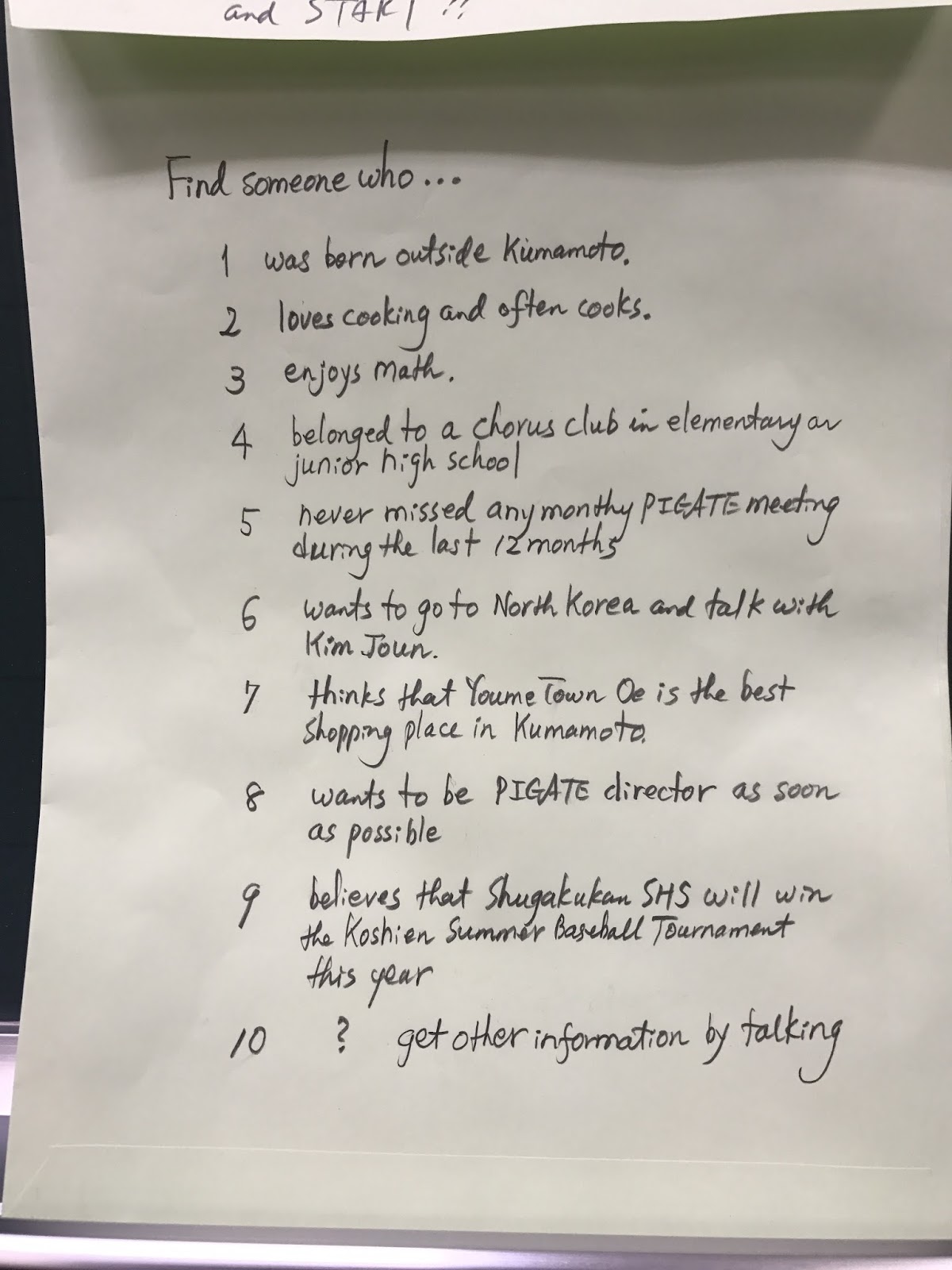
In the morning on Aug. 12, at PIGATE's Special Summer Session (SSS), Mr. Nobuyuki Takaki led a find-someone-who activity, which he introduced with "instruction checking questions" (The PIGATE Blog, 2017.06.01), and 10 interaction prompts that he'd printed on a large envelope (snapshot below).
Find-someone-who interaction prompts for the SSS, 2017.08.12
Afterwards, when participants had shared their findings, and were reflecting on the activity in general, Mr. Takaki made a point of mentioning that it had been an integrated-skills activity, in which participants had listened, read, spoken, and written. When I feigned surprise that participants had used all four basic skills (listening, reading, speaking, and writing) during the activity, Mr. Takaki reiterated the point, so I'm quite certain that participants got it.
Paul Beaufait, The Prefectural University of Kumamoto
This post provides a preview of slides in the works for Saturday's big event. It also includes a Tweet feed display for the Twitter hashtag #higopigateSSS.
Tweet about it: #higopigateSSS
Relevant comments and questions are more than welcome!
There ... [was to be] a graphic display below (hopefully;-) of results from the OECD Teaching and Learning International Survey (TALIS 2013). It appeared in a 2014 news article entitled:
Teachers love their job but feel undervalued, unsupported and unrecognised ...
[However, the embedding code hasn't worked, so I've removed it.]
There's a four-page summary of findings from Japan here:
This post showcases a presentation that Taishi Kaneko (KU, Fac. of Educ., M2) used for a demonstration and discussion of instruction checking questions (ICQs) at the PIGATE gathering earlier this month (2017.05.13). Taishi began to develop his interest in ICQs while studying overseas last year.
If you have comments or questions regarding ICQs and their use or potential, please feel free to spell them out in comments on this post. Suggestions of and pointers to related resources also are welcome.