Pages

Wednesday, August 10, 2016

PIGATE's Special Summer Session: August 13, 2016

This post ... includes ... a slideshow introducing PIGATE's Special Summer Session [SSS] at the Prefectural University of Kumamoto, August 13, 2016. [It also may display recent earmarked Tweets about or related to the SSS.]


You can find the working agenda for this year's SSS in the PIGATE calendar on the Calendar of Events page of The PIGATE Blog. Directions to the SSS venue are on the Meeting Location page.

Tweet about it: #higopigateSSS


[74 words]

PS: Here are a few snapshots from the SSSession.


Thanks to Misato for rounding up delicious boxed lunches from RanTen in Mashiki-machi!


[+ 23 words]

Friday, July 29, 2016

Social Media for You and Me? (summary)

Social Media for You and Me?
A reflective summary
by Paul Beaufait


First of all, I'd like to thank the directorate and membership of PIGATE for the opportunity that Mr. Hirotaka Terada and I had to make an extended presentation about social media for PIGATE, at Kumamoto Gakuen University (KGU) on June 11th, 2016. It was encouraging to see how determined the director, Mr. Nobuyuki Takaki, and other members of the group were to resume PIGATE-style grassroots teacher development activities, in spite of severe consequences of earthquakes in Kumamoto. I'd like to extend special thanks to Prof. Joseph Tomei for making arrangements for the PIGATE group to meet at KGU in both June and July.


In the aftermath of the tremors, which necessitated cancellation of the PIGATE gathering in May, it was a challenge to plan and develop contributions for a joint presentation entirely at a distance. Though Terada and I had exchanged a few ideas face-to-face after the meeting in April, we depended completely upon internet communication technology (ICT) from then until we met again at KGU a few minutes before the June meeting began. So this had become an opportunity to both explore and employ handy and useful online media in collaborative presentation development.


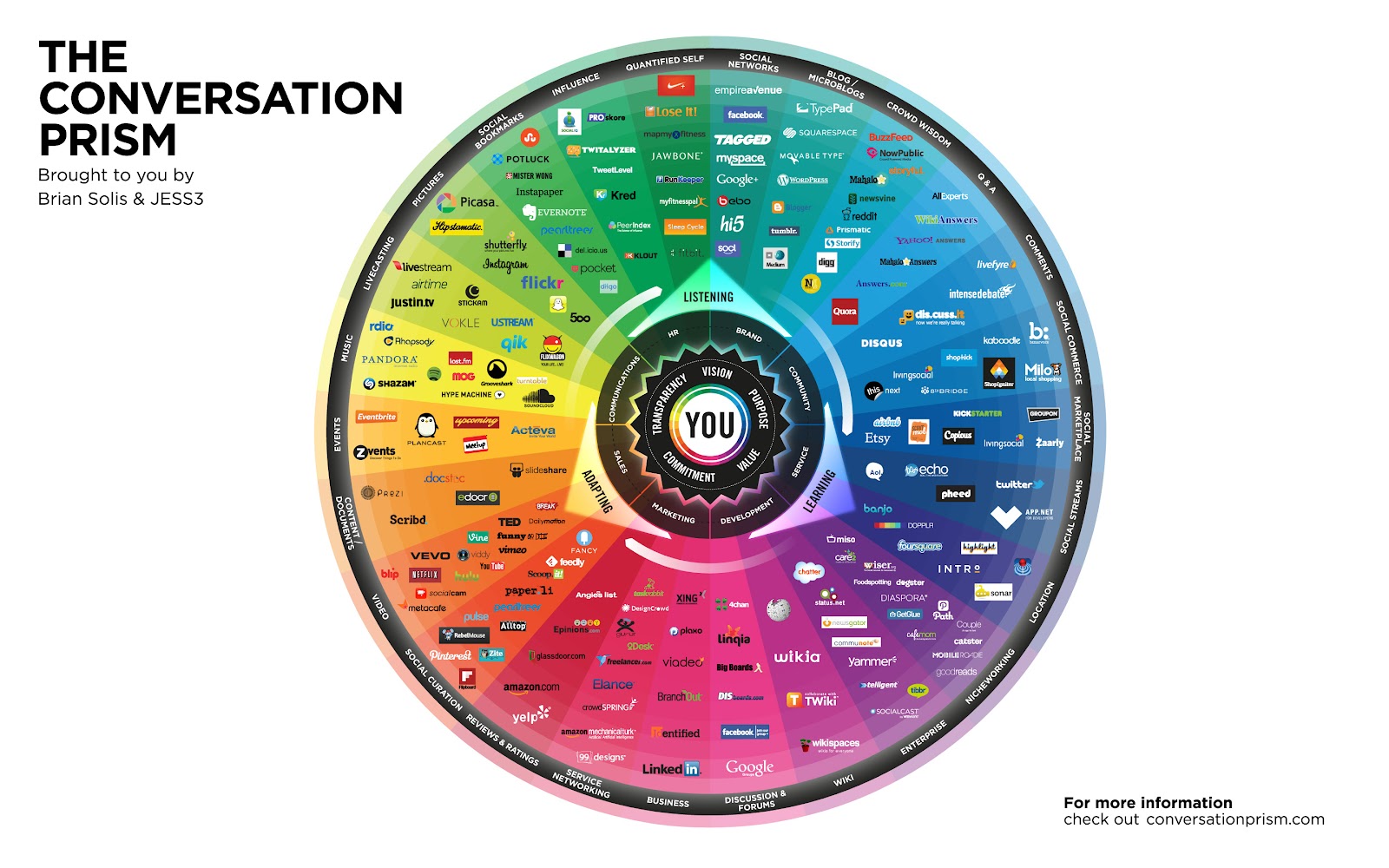
Beyond 1) basic email service (Gmail) underpinning our initial contacts and endeavours, 2) a social networking service that both presenters use regularly (LINE), and 3) a shared Google presentation around and on which to collaborate; possible social media upon which to focus our presentation were virtually uncountable (see: The Conversation Prism 4, 2014, below).
JESS3_BrianSolis_ConversationPrism4_WEB_2880x1800.jpg


Our shared Google presentation, now public on the PIGATE Blog (2016.06.12), included pretest and posttest items to assess audience members' knowledge and beliefs with regard to the nature of social media and uses of them. Pretest responses, the presenters hoped, would lay a foundation for a working definition of social media. Initial discussion of personal and professional purposes rounded out common characteristics of social media that Obar & Wildman (2015) had identified, namely:


  • Internet-based applications (apps),
  • User-generated content,
  • User- and group-specific profiles for apps or websites, and
  • Networking services facilitating connections amongst users and groups.


As had a couple of PIGATE members who'd responded to the Monthly Special prompt for the Dec. 2015 newsletter (No. 267, 2016.01.01, pp. 27-28, https://goo.gl/mQ6Dio), Terada expressed a preference for online communication via LINE (Free calls and messages). So the presenters used LINE for Voice-over Internet Protocol (VoiP, https://goo.gl/D4YMBG) calls to talk through research and development of their presentation, as well as for text messages to arrange and follow-up on those VoIP calls.


Terada's findings reflected extended discussions with twenty classmates and friends, who'd used mainly LINE, Facebook, and Twitter, and to a lesser extent Instagram. Those discussions explored various merits and demerits of social networking service (SNS) use, as well as trouble that users or their friends had encountered. In a nutshell, Terada found such SNSs useful for one-way distribution of information, yet problematic when responses were desirable or necessary.


Beaufait pointed out benefits of social media use that the Online Learning Consortium (2016) had reported for online instructional programs, in particular potential for:


  1. Learner engagement (and retention),
  2. Instructional effectiveness–achieving desired learning outcomes, and
  3. Provisions of career and educational support services.


Beaufait also called attention to passive (automatically collected) and active (individually produced) data found in so-called digital footprints, or virtual representations of our real-life selves (Oglethorpe, 2012). Such footprints may work either against or for job-seekers, professional program applicants, or students in general. Beaufait noted that, in the eyes of some schools, "A Google search result is your portfolio" (Leigh Blackall, Teaching and learning online [TALO] Google group mailing list, 2016.06.01, emphasis added).


Discussion periods throughout the presentation explored numerous questions–many more than possible to answer in-session to everyone's satisfaction, for example:


  • What's social about social media–if people use them merely as tools for broadcasting personal information, rather than for facilitating and promoting educational exchanges or socially responsible endeavours;
  • What changes may be taking place in attitudes and practices with respect to privacy and control of personal information in highly-interconnected online communities, groups, and networks; and
  • What can we as educators and language learners do to maximize benefits and minimize risks of social media use, for both personal and professional purposes, as well as for students–young ones in particular, whom we may serve as trail-breakers, role-models, guides, or coaches?


Among the references for our presentation in the slideshow on the PIGATE Blog, I'd like to highlight Davis (2015) as the source for Web-guides for teachers (currently slide 54), and to double up on Couros (2011, 2013, 2016a, & 2016b). George Couros (@George Couros, https://goo.gl/0c4J1T) not only granted permission for use of a custom graphic in animation of Bringing community into classrooms (currently slide 58), but also has provided numerous examples and suggestions of ways to use Twitter for professional development purposes.


In wrapping up here, I'd like to encourage everyone, social media users and non-users alike, to review public pre- and post-session tweets here (https://goo.gl/s3K1lu). I also hope you'll take active parts in on-going and future conversations and explorations of potential uses for social media in additional language and professional network development–for both learning and teaching purposes.


Please allow me to close with thanks to all who took part in the June gathering, and a reminder from our presentation (Social media sufficiency, currently slide 62):


"[C]ollaborative conversations alone are often not enough to promote teacher learning and change. Teachers must try complex innovations, and reflect upon these implementations in order to extract from experience the knowledge that leads to improved teaching."
(Alderton, Brunsell, & Bariexca, 2011)


Paul Beaufait ボーフェ ポール
Prefectural University of Kumamoto 熊本県立大学

Version 20160729b
This is a revised version of an article that
originally appeared in PIGATE Newsletter 272 (2016.07.04).
[989 words]


Monday, June 13, 2016

Nik's Learning Technology Blog: 20 + Things you can do with QR codes in your school

Those of you who've had an opportunity to peruse the slides in Social media for you and me (Beaufait & Terada, 2016.06.11) will have seen dozens of QR codes pointing out various online resources.

Here's another one:
http://goo.gl/pxDilp


It points to a 25 September 2015 post by Nik Peachey that tickled a strand in my Diigo social bookmarking network today: Nik's Learning Technology Blog: 20+ Things you can do with QR codes in your school

Nik's an English language teaching and technology guru that I met several years ago through a series of virtual workshops entitled Blogging for Beginners and Blogging for Educators. EdTechTalk is a Diigo group with which he shared that post 7 June 2016.

If you have any questions about QR codes or suggestions of other ways to use them around your schools, please do not hesitate to spell them out in comments on this post.
[150 words]

Sunday, June 12, 2016

Social media for you and me? (Beaufait & Terada, 2016.06.11)

Here is the slideshow from our presentation about social media at the PIGATE gathering on June 11, 2016:


We'd love to read [and respond to] concerns, questions, and suggestions regarding social media for learning, teaching, and professional development, both from attendees and from people who were unable to attend the session at KGU. Please feel free to spell them out either in comments on this post or in tweets to #higopigate20160611.

[45 words {+3}]

Friday, June 10, 2016

Twittering _for_ children (pab's first tweet)


Sounds good for adults, too, doesn't it?

Wednesday, April 6, 2016

Flashback: Introducing Hap Palmer to Japan (Yoneoka, 2015.01.09)

This post is a follow on to Prof. Judy Yoneoka's guest speaker presentation last January (2016.01.09). The converted slideshow below includes active links to numerous musical resources that she used to demonstrate classroom activities.

As a newsletter write-up explained:
[She] is a professor in the Department of English and American studies at Kumamoto Gakuen University. Her major research theme is world Englishes.
(PIGATE Newsletter, 268, p. 4)


Introducing Hap Palmer to Japan (Yoneoka, 2015.01.09 [converted])


A few additional musical resources are listed in a previous post, along with a call for more resource suggestions: Music for children: Online resources (2016.01.22).

[100 words]

Monday, March 28, 2016

Did Ford.ca get your farther–further grammar goat?


Should Ford have used the word farther instead of further for promotional displays at the Women's World Curling Championships? They definitely needn't have capitalized the F-word in their tagline, and missed out sentence final punctuation as well.


Word-choice arguments, as you might imagine, can go full circle. For starters, an Oxford Dictionaries' grammar and usage resource made no distinctions, when talking about distance; it argued, "[B]oth are equally correct."

But isn't that like arguing two stones are equally close to the center of the house? If you watched the end of semi-final play between Japan and Russia yesterday (relative time), you may recall that the Japanese team quickly conceded a second point for closeness in the house on the 10th end, and won outright with two points of their own in the 11th.

Thus, perhaps, the Oxford Dictionaries' site conceded, "... [except] in various abstract and metaphorical contexts" (http://www.oxforddictionaries.com/words/farther-or-further).

Cambridge Dictionaries Online's argument included similar nuances: "There is no difference in meaning between them," when talking about distance. However, "[t]here are some occasions when we can use further[,] but not farther. / We use further before a noun to mean 'extra', 'additional' or 'a higher level'"
(http://dictionary.cambridge.org/us/grammar/british-grammar/farther-farthest-or-further-furthest).

The Canadian Oxford Dictionary Online called farther a "var[iant] of further …" (2005, inaccessible after first viewing), but wouldn't reveal the definition of further without a purchase or subscription. The definition of one word isn't much of a sample to preview, eh?

Grammar Girl surmised, "The quick and dirty tip is to use 'farther' for physical distance and 'further' for metaphorical, or figurative, distance. It's easy to remember because 'farther' has the word 'far' in it, and 'far' obviously relates to physical distance" (http://www.quickanddirtytips.com/education/grammar/further-versus-farther).

Grammar Monster concluded, "If you're unsure which to use[,] because it's difficult to make a distinction between physical and figurative distance, opt for further" (http://grammar-monster.com/easily_confused/further_farther.htm).

You don't think Ford marketeers were unsure, do you? 

[315 words]

Monday, March 14, 2016

Junior high students' presentation on school trip to Singapore

Our 一貫 [ikkan] students (1st yr JH - 2nd yr HS at Shokei) gathered for a Powerpoint presentation by our 3rd yr JH students about their school trip to Singapore last month. They had put together slides showing what they had seen and done as well as differences they had noticed between the school they visited in Singapore and Shokei.

Two surprising ones were that there was no A/C in the classrooms (and it was more humid than Kumamoto in August!) and that the students could have their cell phones on their desks and use them between classes! Some of the places they enjoyed were Marina Bay Sands (with a wonderful night view) and the Night Safari.

The students gave their presentation mostly in English with some Japanese including some Japanese on the screen to help students understand what they were saying. They had used some of the fun animations in Powerpoint to make the "show" even more enjoyable. It was a nice way to share their experience with the teachers and students!

Wednesday, March 2, 2016

Animal sounds galore!

Adaptation of Markham's Lexi the Poodle by pab (2016.03.02)
Some rights reserved (CC BY-SA 4.0)
A professor in Adelaide, Australia, Derek Abbott, has begun studying animal sounds as they would appear in comic strip speech balloons, according to posts in The Guardian and on the Mother Nature Network:
Both posts point to a website displaying Abbott's rather comprehensive collection of Animal Sounds, some transliterated into English from native language scripts. The MNN post also points to the video below featuring native speakers [of various languages] producing animal sounds.


Bow Wow Meow - Animal Sounds in Different Languages from Ke Nguyen on Vimeo.

Can you or, better yet, the learners you teach name all of the countries represented by flags in Nguyen's video?

[160 words {+3}]